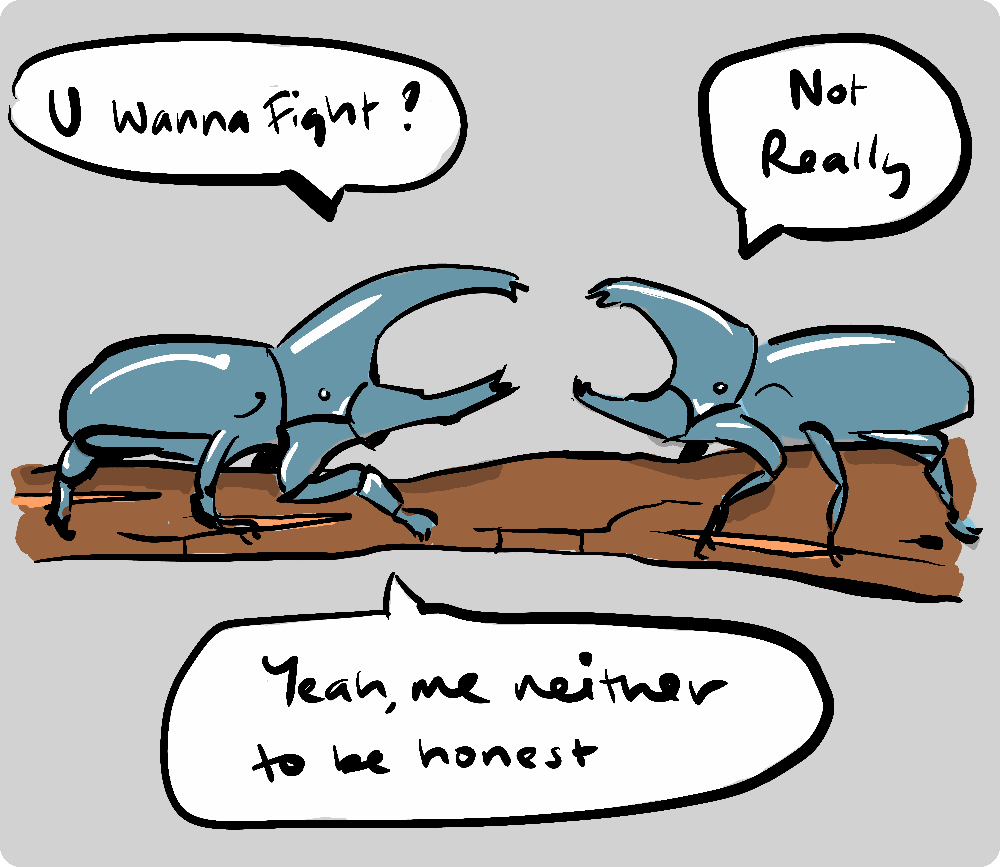
Figure 1:Two Hercules beetles weigh up a contest that neither truly wants. The escalation of conflict, and the conditions under which it is or is not worth it, is a recurring theme in game theory.
What is Game Theory?
A common definition of the subject is:
“Game theory is the study of interactive decision-making where the outcomes of one decision maker’s choices depend on the decisions made by others.”
While this definition captures the essence of strategic interaction, game theory is much more than that. It is a beautiful mathematical discipline with deep theoretical avenues for exploration. It plays a crucial role in the global economy, with multiple Nobel Prizes awarded for contributions to our understanding of markets. It provides models that explain how biological structures, from cells to ecosystems, evolve over time. It offers insights into cooperation, competition, and the formation of social norms.
Because game theory spans multiple disciplines, no single definition fully captures its scope. This book aims to provide a solid understanding of game theory: what it can do and how to apply it.
Who is this book for?
This book is written primarily for advanced undergraduate mathematicians and computer scientists. It may also serve as a starting point for early-career researchers seeking a practical understanding of game theory.
However, the book aims to be accessible to aspiring game theorists from any discipline. A psychologist modelling a specific behaviour? A conservationist analysing the conditions under which a policy is likely to succeed? An economist studying strategic interactions in competitive markets? A computer programmer implementing a game-theoretic algorithm? Whatever your background, this book provides the necessary tools to engage with game theory in a meaningful way.
The book includes appendices that introduce mathematical theory independently of game theory. For some readers, these may serve as a review of familiar topics, while for others, they offer a first introduction to key techniques needed to apply game-theoretic ideas effectively.
Each chapter includes a section demonstrating how software can be used to apply the ideas at scale. These sections assume some familiarity with Python and the ability to install external libraries. For an introduction to these topics, see the chapters on Using Notebooks and Installing Libraries in the Python for Mathematics text.
Game theory is a field that thrives on cross-disciplinary insights, and this book is designed to help readers from different backgrounds develop a shared mathematical foundation. Whether your interest is theoretical or applied, the goal is to equip you with the tools to explore game theory with confidence.
Licence and access
There will always be a free online version of this book, available at
vknight.org/gtb. A PDF version is built alongside the
site and can be downloaded from
vknight
The book brings together material under three sets of terms. The prose, together with the figures and diagrams created by the authors, is released under the Creative Commons Attribution 4.0 International Licence (CC BY 4.0), so it may be shared and adapted with attribution. The source code, including the executable code cells and the build tooling, is released under the MIT Licence.
The illustrations are the work of James Brown (nonzerosum.games)
and are treated differently. They remain the copyright of their creator and are
included here by permission. They are not covered by the CC BY 4.0 licence
that applies to the rest of the book: James Brown retains full ownership of the
illustrations, may continue to use them and any variants of them in his own work,
and any reuse of an illustration outside this book requires his permission. Full
details are in the LICENSE and ILLUSTRATIONS.md files in the repository.
Citing this book
If this book contributes to your work we would appreciate a citation. A suggested plain-text form is:
Knight, V. and Brown, J. (2026). Game Theory: Theory, Software, Research. Available at vknight.org/gtb.
The corresponding BibTeX entry is:
@book{knight2026gametheory,
  author = {Knight, Vincent and Brown, James},
  title  = {Game Theory: Theory, Software, Research},
  year   = {2026},
  url    = {https://vknight.org/gtb/},
}
The repository also includes a
CITATION.cff
file, from which GitHub can generate a citation in a number of common formats.
What does this book cover?
The book is organised into three broad themes.
Foundations of strategic interaction. The opening chapters establish the core language of game theory. The Games chapter introduces normal and extensive form representations, strategies, and utilities. Rationalisation develops the idea of best responses and iterated elimination of dominated strategies. Zero-Sum Games shows how minimax optimisation and linear programming characterise optimal play when players’ interests are directly opposed. Nash Equilibrium formalises the central solution concept, a strategy profile from which no player wishes to deviate unilaterally, and the support enumeration algorithm provides a systematic way to compute it. Subgame Perfection refines Nash equilibrium for extensive form games by requiring rationality at every decision node, not just on the equilibrium path.
Dynamics and long-run behaviour. The middle chapters study how equilibria arise and persist over time. Repeated Games examines how cooperation can be sustained when players interact indefinitely, culminating in the Folk Theorem. Direct Reciprocity extends this to memory-one strategies, showing how simple conditional rules such as Tit-for-Tat can stabilise cooperation. Evolutionary Biology provides the wider biological context for evolutionary game theory and motivates the dynamical models that follow; it is optional reading for a purely mathematical pass through the book. Replicator Dynamics models how strategy frequencies evolve in large populations under selection pressure. The Moran Process studies fixation in finite populations. Learning and Evolutionary Dynamics examines how the choice of update rule (imitation, best response, or generational turnover) shapes long-run outcomes across these models. Best Response Polytopes introduces the Lemke–Howson algorithm as a geometric method for computing Nash equilibria in two-player games.
Allocation and collective choice. The final chapters apply game-theoretic reasoning to settings where resources, partners, or decisions must be shared. Routing Games studies how selfish routing decisions lead to inefficiency (the Price of Anarchy). Matching Games covers the Gale–Shapley algorithm and stable matchings. Auction Games analyses first- and second-price auctions and Bayesian equilibrium bidding strategies. Social Choice investigates collective decision-making and impossibility results. Cooperative Games considers coalition formation, the characteristic function, and the Shapley value.
Six appendices provide self-contained mathematical background: numerical integration, absorbing Markov chains, ergodic Markov chains, interior point optimisation (KKT conditions), integer pivoting, and order statistics.
Throughout, the emphasis is on games of complete information, in which the players, their available actions, and their payoffs are common knowledge. This is the classical setting in which the core solution concepts are cleanest to state and compute. Games of incomplete information, where players hold private information about their own payoffs, enter only in the Auction Games chapter, through the notion of a Bayesian Nash equilibrium among bidders with private valuations. A systematic treatment of Bayesian games, mechanism design, and signalling lies beyond the scope of this book, and is a natural direction for further study; the auctions chapter is intended as a first point of contact with these ideas rather than a complete account of them.
How is this book different from similar books?
There are a number of excellent books on game theory that are highly recommended. For a fantastic introduction to the topic aimed at a mathematical audience, see Webb, 2007. The exhaustive work Maschler et al., 2020 offers a vast amount of breadth and depth on the subject, while Roughgarden, 2010 delves into modern algorithmic approaches to modelling complex systems at an advanced level.
Some excellent texts focus on specific subtopics within the domain. For example, Gusfield & Irving, 1989 explores matching games, and Roughgarden, 2002 addresses routing games. Other great general introductions include Osborne & others, 2004, Watson, 2002, and Gusfield & Irving, 1989, to name just a few.
This book, however, offers something that these fantastic works do not: detailed implementation instructions, including multiple examples and exercises that show how to solve specific problems, even when they are large and complex. It also provides an overview of open-source software tools that are readily available to solve real-world problems. The book also includes discussion of relevant contemporary research aiming to demonstrate not only how the topic is applied in practice but also its relevance. Finally, it offers a rigorous theoretical foundation, serving as a springboard for deeper theoretical analysis.
How is this book organised?
Each chapter in this book follows a structured format:
A motivating case study: a running example throughout the chapter to illustrate and contextualise the theory, often drawing from real-world scenarios.
Relevant definitions and theory: providing a rigorous mathematical foundation for the chapter’s topic.
Exercises: a range of problems inviting the reader to apply the definitions and theory to deepen understanding.
Practical implementations: including Python code, and an overview of relevant open-source tools to guide implementation.
Contemporary research: a hand-picked, non-exhaustive overview of relevant research related to the chapter.
Some readers may prefer to focus on the theoretical foundations, while others might engage primarily with the examples and practical implementations. This book is designed to be flexible, allowing readers to approach the material in a way that best suits their background and interests.
Figure 2 shows the general structure of the book and how the various chapters link together.
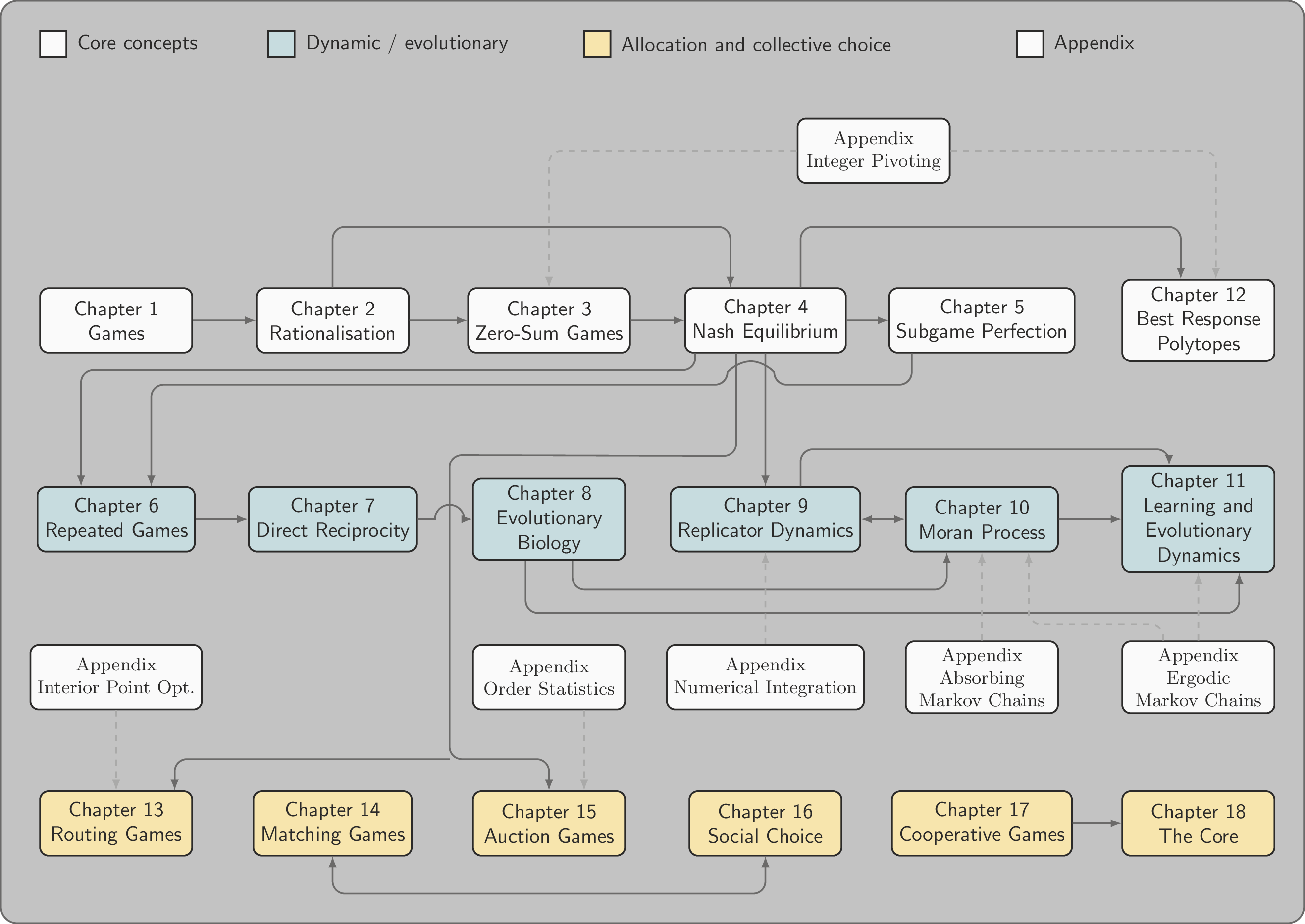
Figure 2:Visual representation of the relationships and flow between chapters.
- Webb, J. N. (2007). Game theory: decisions, interaction and Evolution. Springer Science & Business Media.
- Maschler, M., Zamir, S., & Solan, E. (2020). Game theory. Cambridge University Press.
- Roughgarden, T. (2010). Algorithmic game theory. Communications of the ACM, 53(7), 78–86.
- Gusfield, D., & Irving, R. W. (1989). The stable marriage problem: structure and algorithms. MIT press.
- Roughgarden, T. A. (2002). Selfish routing. Cornell University.
- Osborne, M. J., & others. (2004). An introduction to game theory (Vol. 3). Springer.
- Watson, J. (2002). Strategy: an introduction to game theory. (No Title).