6. The capstone
We now prove the theorem the notes have been building towards: every evolutionarily stable strategy is a symmetric Nash equilibrium.
On paper the argument is three lines. Let \(x^*\) be an ESS and take any strategy \(y\). If \(y = x^*\), then \(u(y, x^*) = u(x^*, x^*)\) and there is nothing to show. Otherwise the ESS condition gives either \(u(y, x^*) < u(x^*, x^*)\) or \(u(y, x^*) = u(x^*, x^*)\), and either way \(u(y, x^*) \le u(x^*, x^*)\).
We emphasise that this argument never asks what \(u\) is. It uses only the two definitions and the fact that a strict inequality, or an equality, implies a weak one. The Lean proof has the same property, and so it holds for every game at once.
Create GameTheory/Capstone.lean, add it to GameTheory.lean, and begin:
The statement and the proof
Here is the whole theorem:
/-- Every evolutionarily stable strategy is a symmetric Nash equilibrium. -/
theorem IsESS.isSymmetricNash {Strategy : Type} {payoffs : Strategy → Strategy → ℝ}
    {resident : Strategy} (stable : IsESS payoffs resident) :
    IsSymmetricNash payoffs resident := by
  intro deviation
  by_cases same : deviation = resident
  · rw [same]
  · rcases stable deviation same with worse | ⟨tie, _⟩
    · exact le_of_lt worse
    · exact le_of_eq tie
The statement reads: for any type of strategies, any payoff function and any
resident strategy, given a proof stable that the resident is an ESS, the
resident is a symmetric Nash equilibrium. The first three arguments are in
braces, because Lean can infer them from stable. The hypothesis itself is an
ordinary argument, since a proof is a value like any other.
The name IsESS.isSymmetricNash places the theorem in the IsESS namespace.
We will see why that is convenient at the end of the chapter.
The goal at each step
At the start the context holds everything the statement introduced:
Strategy : Type
payoffs : Strategy → Strategy → ℝ
resident : Strategy
stable : IsESS payoffs resident
⊢ IsSymmetricNash payoffs resident
Compare this with every earlier proof. Here payoffs is not our Prisoner's
Dilemma function but an arbitrary one, about which the context says nothing.
There is no norm_num [payoff] to fall back on. Whatever we prove, we prove
from stable alone.
intro deviation unfolds the Nash condition as in chapter 5, leaving:
We show only the new line of the context from here on.
Two cases
The paper proof splits on whether the deviation is the resident itself.
by_cases same : deviation = resident does exactly that. It produces two
goals, one assuming the statement and one assuming its negation:
case pos
same : deviation = resident
⊢ payoffs deviation resident ≤ payoffs resident resident

case neg
same : ¬deviation = resident
⊢ payoffs deviation resident ≤ payoffs resident resident
Unlike cases in chapter 4, which split on the two constructors of Action,
by_cases splits on any statement at all. Our Strategy type is arbitrary,
so there are no constructors to split on, but there is always the question of
whether two strategies are equal.
In the first case, rw [same] rewrites every deviation in the goal to
resident. The goal becomes payoffs resident resident ≤ payoffs resident
resident, and rw closes a goal that holds by reflexivity once it has
finished rewriting. That single line is the "nothing to show" of the paper
proof.
The hypothesis at work
The second case is where stable is used. stable is a proof of a ∀
followed by an implication, so as in chapter 5 we apply it like a function:
first to deviation, then to same, the proof that the deviation differs
from the resident. The result, stable deviation same, is a proof of the
disjunction for this particular deviation.
rcases takes such a proof apart. The pattern worse | ⟨tie, _⟩ says that
the disjunction has two alternatives, separated by |. The first is named
worse. The second is a conjunction, whose two halves the angle brackets
⟨ ⟩, typed \< and \>, name tie and _. Two goals result:
case neg.inl
worse : payoffs deviation resident < payoffs resident resident
⊢ payoffs deviation resident ≤ payoffs resident resident

case neg.inr
tie : payoffs deviation resident = payoffs resident resident
right✝ : payoffs deviation deviation < payoffs resident deviation
⊢ payoffs deviation resident ≤ payoffs resident resident
The underscore asked Lean not to name the second half of the conjunction, and
it appears in the context as right✝. The dagger marks a hypothesis we cannot
refer to. An interesting observation is that this is the second-order
condition of the ESS, the part that makes evolutionary stability stronger than
Nash equilibrium, and the proof never needs it. The Nash property comes from
the first-order condition alone, which the Lean proof makes impossible to
overlook.
Each remaining goal asks for a weak inequality, and the context already
contains a strict one or an equality. exact finishes a goal by supplying a
proof of precisely that goal. Mathlib's le_of_lt turns a proof of a < b
into a proof of a ≤ b, and le_of_eq does the same from a = b, so
le_of_lt worse and le_of_eq tie are exactly what is needed.
With the cursor on the first exact, the infoview shows only the goal that its
bullet is working on, case neg.inl, with worse in the context:
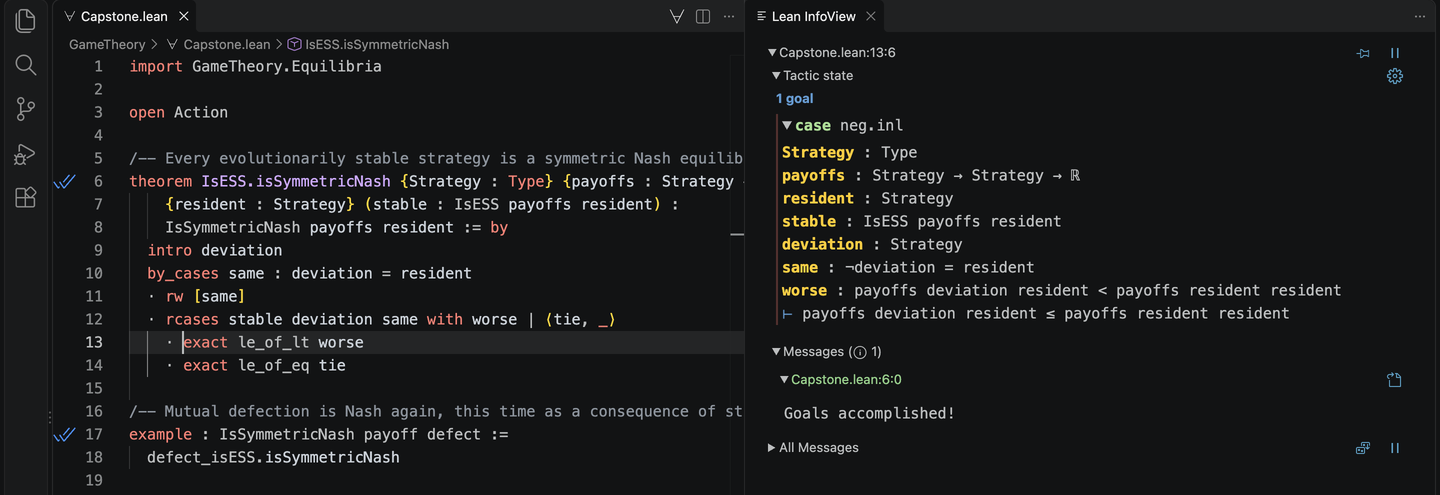
Those names follow the convention from chapter 3 and can often be guessed. When
they cannot, the tactic exact? searches Mathlib for a lemma that closes the
goal. In the first case it answers:
This is the same fact from Lean's standard library rather than Mathlib, and either works.
The theorem in use
The theorem is now available for any game. In particular, it gives a second proof that mutual defection is a Nash equilibrium of the Prisoner's Dilemma:
/-- Mutual defection is Nash again, this time as a consequence of stability. -/
example : IsSymmetricNash payoff defect :=
  defect_isESS.isSymmetricNash
No tactics are involved. defect_isESS from chapter 5 has type IsESS payoff
defect. Because our theorem lives in the IsESS namespace, Lean lets us
write defect_isESS.isSymmetricNash, finding the theorem from the type of
the proof and filling in the implicit arguments. This dot notation is used
throughout Mathlib, and it is why we chose the name.
We now have two proofs of the same fact. The one in chapter 5 computed the payoffs; this one uses no payoffs at all and knows only that defection is stable.
Where we are
We have proved that an evolutionarily stable strategy is a symmetric Nash equilibrium, for every symmetric two-player game with real payoffs. The proof is six lines, and every line corresponds to a step of the argument on paper.
Across the six chapters we have met ten tactics: norm_num, intro, cases,
left, have, contradiction, by_cases, rw, rcases and exact,
together with the term rfl and the combinator <;>. That is a small fraction
of Lean, and it was enough to state and prove a real theorem.
Where next
The theorem holds for any type of strategies, and that includes mixed ones.
Taking Strategy to be the probability simplex and payoffs to be the
expected payoff, the result applies unchanged; the work lies in defining those
two objects, not in the proof. Define expected payoffs for mixed
strategies does exactly that, and Verify a mixed
ESS in Hawk-Dove uses it to prove that playing
hawk half the time is stable, and hence, by this chapter's theorem, a Nash
equilibrium.
For game theory well beyond these notes, the
elazarg/GameTheory library
formalises Nash, correlated and Bayesian equilibria, sequential and repeated games, and mechanism design. Notably, it
proves the existence of mixed Nash equilibria, as exists_isNash_mixed via
Kakutani's fixed point theorem, and it contains its own version of this
chapter's theorem. That version defines an ESS differently, with the Nash
condition as its first clause, and its proof is correspondingly different. Why
two equivalent definitions lead to such different proofs is discussed in
Definitions and proofs.
The library is under active development, so we cite the version we read by its
commit, the identifier git gives to each saved version of a project. The link
1dba332 shows the code exactly as it stood when we examined it, on
24 September 2026, even if names or proofs have changed since.