3. The first proof
We now prove something. The statement is deliberately small, that a defector does better than a cooperator against a defector, so that all the attention goes to the machinery rather than the mathematics.
Create GameTheory/FirstProof.lean, and add import GameTheory.FirstProof to
GameTheory.lean as before. The new file begins:
A statement to prove
Start with an equation. The temptation payoff is 5, and we can ask Lean to agree:
Read the shape of that before the content. It is the same shape as the
definition in chapter 2: a name, a colon and something, then := and
something. In chapter 2 the thing after the colon was ℝ and the thing after
:= was 5. Here the thing after the colon is a statement and the thing after
:= is a proof.
That parallel is not a coincidence and it is the central idea of Lean. A
statement is a type, and a proof of it is a value of that type, in exactly the
way that 5 is a value of type ℝ. Checking a proof and checking that 5 is a
real number are the same operation.
example means we are not giving the result a name, because we do not intend
to use it again.
The goal
by switches from writing a proof directly to building one with tactics, and
this is where the infoview earns its place. Put the cursor after by and Lean
shows:
In the editor, with the cursor on line 7, the goal appears under Tactic state:
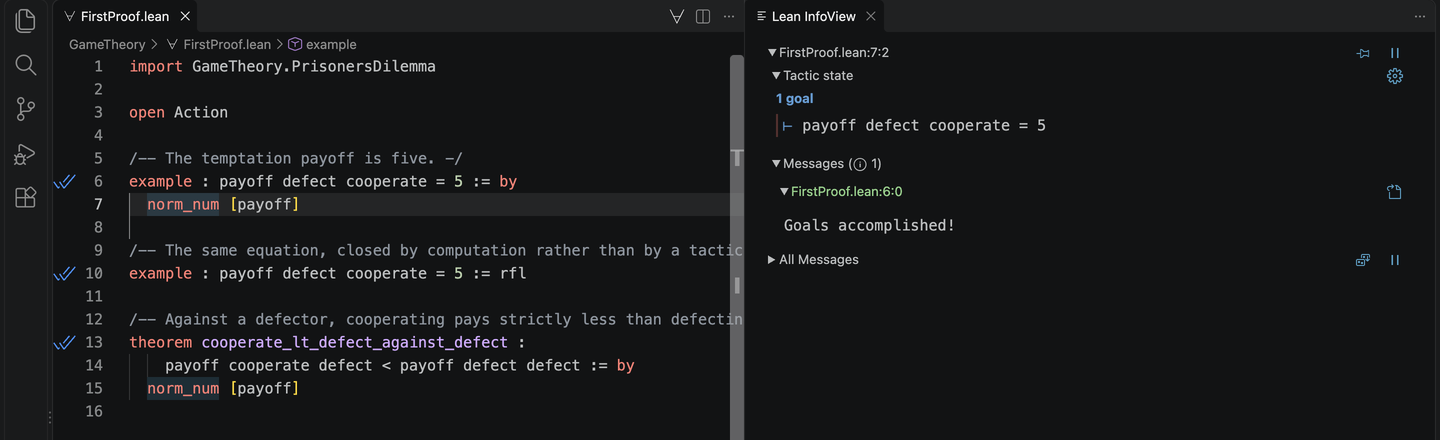
The turnstile ⊢ separates what we may assume, which is nothing yet, from what
we must show. This is the goal. A tactic transforms the goal, and the proof is
finished when there are no goals left. If we write a tactic block that does not
finish, Lean says so:
In the editor, a failing proof is hard to miss. Here line 7 has been changed
to a plain norm_num, a mistake the next section explains. The by is
underlined in red, a marker appears in the margin, and the infoview shows the
error under Messages, with the goal that remains:
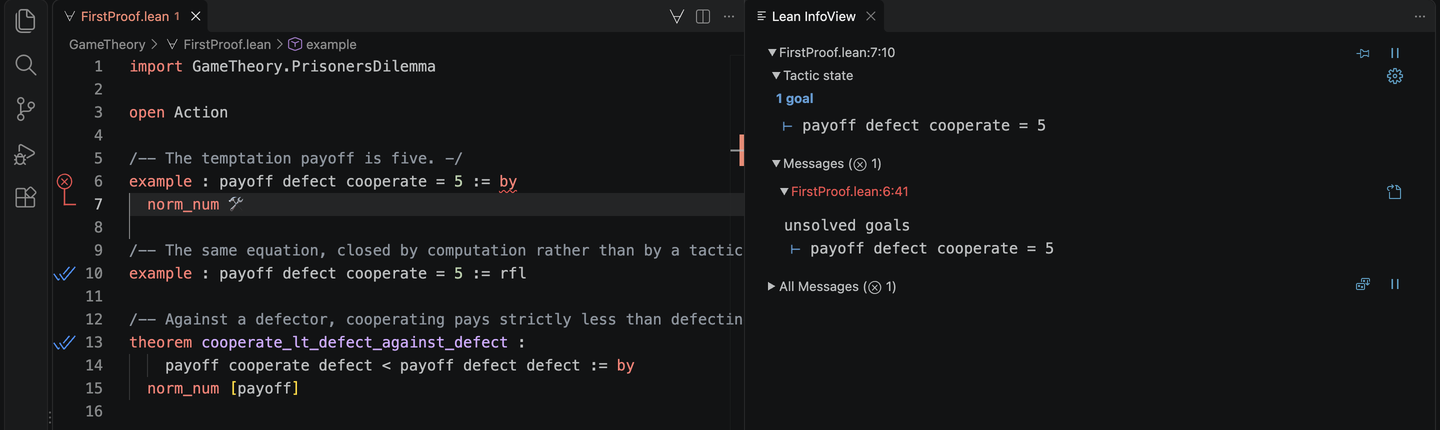
That message is not a failure of the setup. It is Lean telling us exactly how far we got, and we will see it often.
Why the tactic needs a hint
norm_num is the tactic for goals that are arithmetic once everything is
written out. Here it is passed [payoff], and the brackets matter. Without
them:
is where norm_num stops, having made no progress at all. There is no
arithmetic visible to it. The goal mentions payoff, which as far as the
tactic is concerned is an opaque name.
Writing norm_num [payoff] tells the tactic that it may also unfold the
definition of payoff. It then sees 0 < 1, which it disposes of
immediately. Passing definitions and lemmas in brackets like this is how most
Lean tactics are steered, and forgetting to do it is the most common reason a
tactic that ought to work does not.
A proof with no tactics at all
The same equation can be closed without entering tactic mode:
/-- The same equation, closed by computation rather than by a tactic. -/
example : payoff defect cooperate = 5 := rfl
rfl is the proof that something equals itself. It works here because
payoff defect cooperate and 5 are the same by definition: Lean unfolds the
pattern match, reaches the literal 5, and finds both sides identical. No
reasoning was required, only computation.
It is worth knowing rfl exists, and worth knowing its limits. Try it on the
inequality and Lean objects:
Type mismatch
  rfl
has type
  ?m = ?m
but is expected to have type
  payoff cooperate defect < payoff defect defect
rfl proves equalities and nothing else. An inequality between real numbers
is a genuine mathematical claim rather than a computation, and it needs a
tactic that knows about order.
A named theorem
Our actual target gets a name, because later chapters will refer to it:
/-- Against a defector, cooperating pays strictly less than defecting. -/
theorem cooperate_lt_defect_against_defect :
    payoff cooperate defect < payoff defect defect := by
  norm_num [payoff]
theorem is example with a name attached. The name follows the Mathlib
convention of describing the statement in snake case, so that
cooperate_lt_defect_against_defect can be read off as: cooperate is less
than defect, against a defector. Names in Mathlib are long and predictable on
purpose, since that is what makes several hundred thousand of them
searchable.
The statement runs onto a second line, indented, which is ordinary Lean layout and carries no meaning beyond fitting the page.
One tactic that will not help
Since Action has only two values, it is natural to reach for decide, the
tactic that settles a goal by running a decision procedure. It fails, at
length:
Tactic `decide` failed for proposition
  payoff cooperate defect < payoff defect defect
because its `Decidable` instance
  ...
did not reduce to `isTrue` or `isFalse`.
The obstruction is not the actions, which are finite and perfectly decidable. It
is the real numbers. Comparison of reals in Mathlib is defined using classical
reasoning, which asserts that a comparison has an answer without providing a way
to compute it, so there is nothing for decide to run. This is the same fact we
met in chapter 2 when #eval returned a Cauchy sequence, and it is taken up
properly in Computation and the real numbers.
Where we are
We have proved a statement about the Prisoner's Dilemma, and met the four
things that every later proof is made of: a statement is a type, by opens
tactic mode, the goal is what remains to be shown, and a tactic usually needs
to be told which definitions it may unfold.
So far every proof has been about two specific actions. In chapter 4 we say something about all of them.