4. Quantifiers
Every proof so far has been about two named actions. Real game theory quantifies: a strategy is dominant when it does better against everything the opponent might do. In this chapter we say that in Lean, once, for any game, and then apply it to the Prisoner's Dilemma.
Create GameTheory/Dominance.lean, add it to GameTheory.lean, and begin:
Importing our own module gives us Action, payoff, and everything they in
turn imported, including norm_num.
A definition that is a statement
Here is strict dominance:
/-- One strategy strictly dominates another if it pays strictly more against
every strategy the opponent might choose. -/
def StrictlyDominates {Strategy : Type} (payoffs : Strategy → Strategy → ℝ)
    (better worse : Strategy) : Prop :=
  ∀ opponent : Strategy, payoffs worse opponent < payoffs better opponent
Compare this with payoff in chapter 2. That was a def whose type was ℝ,
so it produced a number. This is a def whose type is Prop, so it produces
a statement. StrictlyDominates payoff defect cooperate is not true or false
in Lean's eyes until something proves it; it is a claim, sitting there,
waiting.
Being able to define statements as freely as numbers is what makes it
possible to build up game theory rather than merely check arithmetic, and it
is why the convention is to name such definitions in upper camel case, as
StrictlyDominates rather than strictlyDominates.
The definition is general. It does not mention Action and it does not
mention our particular game. It takes any type of strategies at all, any
payoff function on it, and two strategies to compare.
Implicit arguments
Notice the braces around {Strategy : Type} where the other arguments have
parentheses. Braces make an argument implicit, meaning Lean works it out
rather than making us write it. When we later write
StrictlyDominates payoff defect cooperate, Lean sees that payoff has type
Action → Action → ℝ and concludes that Strategy must be Action.
We can ask to see the arguments that are usually hidden by prefixing an @:
Reading right to left: the whole thing produces a Prop, and to get there it
consumes a type, a payoff function, and two strategies.
A universal statement
Now the Prisoner's Dilemma:
/-- In the Prisoner's Dilemma, defection strictly dominates cooperation. -/
theorem defect_strictlyDominates_cooperate :
    StrictlyDominates payoff defect cooperate := by
  intro opponent
  cases opponent
  · norm_num [payoff]
  · norm_num [payoff]
Follow the goal through the three tactics, because this is the pattern almost every later proof follows.
At the start the goal is the bare claim:
intro opponent is how one proves a statement beginning with ∀. To show
that something holds for every opponent, take an arbitrary one, give it a
name, and show it for that. Lean unfolds the definition to find the ∀
underneath, and the goal becomes:
With the cursor on the cases line, the editor shows the same state. VS Code
highlights opponent, marking what has changed since the previous tactic:
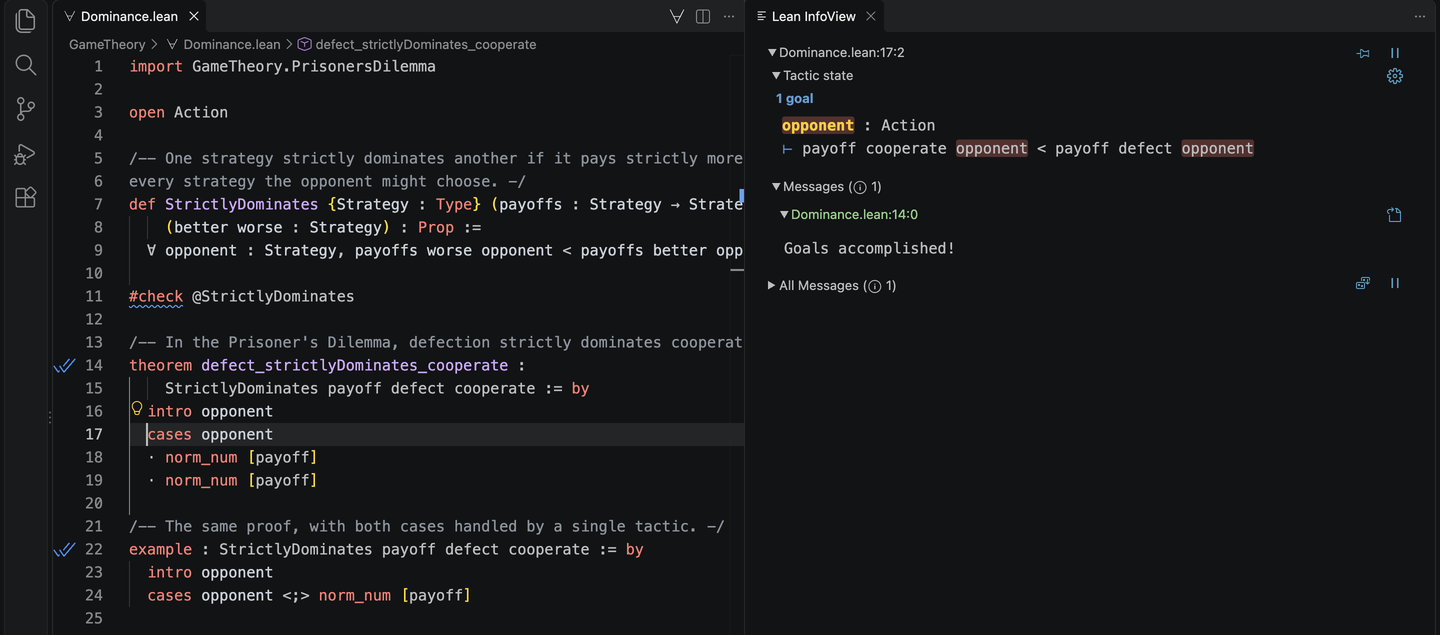
Something new has appeared above the turnstile. That is the context: the things we may now assume. We have an opponent's action, we know nothing about which one it is, and we must prove the inequality for it.
cases opponent uses the fact that Action was declared with exactly two
constructors. There are only two ways an action can have come about, so it
suffices to handle both, and the single goal becomes two:
case cooperate
⊢ payoff cooperate cooperate < payoff defect cooperate

case defect
⊢ payoff cooperate defect < payoff defect defect
The opponent has disappeared from the context, replaced in each goal by the
concrete action of that case. Note that the second goal is exactly the
theorem we proved in chapter 3.
Each · then focuses on one goal, and inside it norm_num [payoff] finishes
the arithmetic as before: 3 is less than 5, and 0 is less than 1.
The bullet · is typed \. and is not decoration. It tells Lean that the
tactics indented under it address one goal only, which keeps a long proof
honest about which branch it is in.
Both cases at once
When the branches are proved the same way, repeating ourselves is tedious:
/-- The same proof, with both cases handled by a single tactic. -/
example : StrictlyDominates payoff defect cooperate := by
  intro opponent
  cases opponent <;> norm_num [payoff]
The <;> combinator runs the tactic on its right against every goal produced
by the tactic on its left. It is idiomatic Lean and worth recognising, though
we write the cases out when they differ, or when we want the proof to be
readable as an argument rather than compact.
Where we are
We have made the step from talking about particular actions to quantifying
over all of them, which needed one new idea in the definition, Prop, and
two in the proof, intro and cases.
We can now say what it means for one strategy to beat another. In chapter 5 we say what it means for a strategy to be a Nash equilibrium, and what it means for it to be evolutionarily stable.