Base Camp: nine days of mathematics in Astana
2026-09-18
I have just finished two weeks teaching in Astana, the opening nine days of the science foundation year (for Computer Science, Civil Engineering and Geology students) at Cardiff University's campus in Kazakhstan. I wrote about my first trip there in February; this time I was back with a new course I designed with the goal of motivating students and hopefully having fun.
I called the course Base Camp, constantly emphasising that it was NOT a boot camp. I taught for nine days with the cohort split into two groups, each taught for 110 minutes, so every day runs twice. Everything a student touched was paper, printed on arrival. No screens were needed.
The structure was four activities, each given two days. On the first day the room played. On the second day I showed the room what it had done. That tick and tock was the whole engine: the students made the data and left not knowing what it said, and I was banking on that being a reason to come back.
I chose the four activities so that in each one the whole room was a single system that nobody was steering, and so that what I revealed was collective rather than personal. The room ran its own tournament, drew its own network, caught its own epidemic, and fed its own common pot. The subject matter and the thing happening in the room were the same thing.
I never stated the point of an activity before it had been played, and that was the rule I was strictest with myself about. The reveal has to earn the meaning, and if I explain first there is nothing left to find out.
Everything is now in a public repository: the day plans, the slides, the printables, and a small Python package that does the analysis in the reveals. None of it was public while the course was running and the students never saw any of it ahead of time, which is the whole point: a reveal only works if nobody has read the ending. The students' own data is not in there, and none of the reveals ever showed a name.
Days one and two: cooperation
Pods of five wrote down a strategy for a repeated Prisoner's Dilemma, sealed it, and handed it in before playing a single round. Forty-two strategies came back, and I sorted them into families.
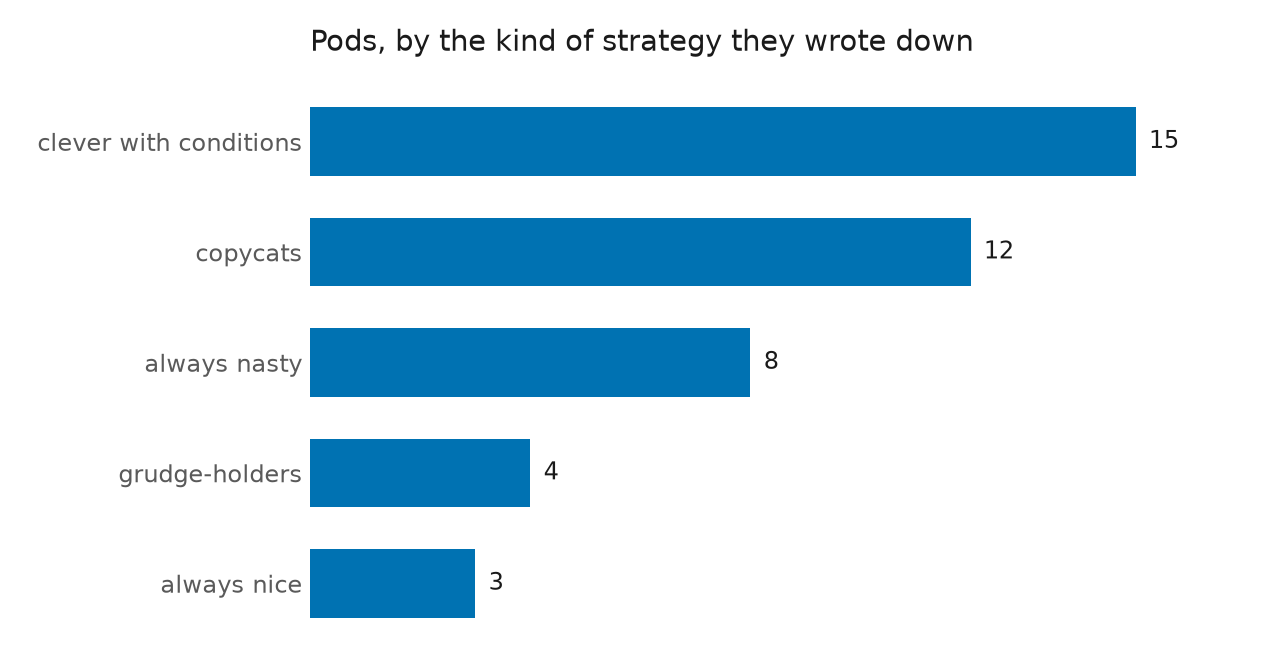
Nineteen of the forty-two pods planned to betray on the first move, and ten wrote a strategy that cooperates the whole way and then betrays on the last turn. Some of them worked out the arithmetic of that final turn entirely unprompted, which was a good thing to read at midnight with a stack of forms.
The part I liked most was the prediction each pod made about everybody else. Twenty-three pods predicted that most pods would betray first. In fact nineteen of forty-two did, so the room expected each other to be worse than they turned out to be. When each tribe then picked one strategy to play a round-robin at the front, five of the nine tribes chose a copycat, and across the twenty matches 63% of all moves played were cooperation.
Days three and four: connections
Every student filled in a tick list of thirty-two things that might be true of them: where they are from, what they play, what they can cook, what they were best at in school. Two people were joined if they shared at least three of those things. Nobody drew an edge to a friend: the edges came out of the ticks.
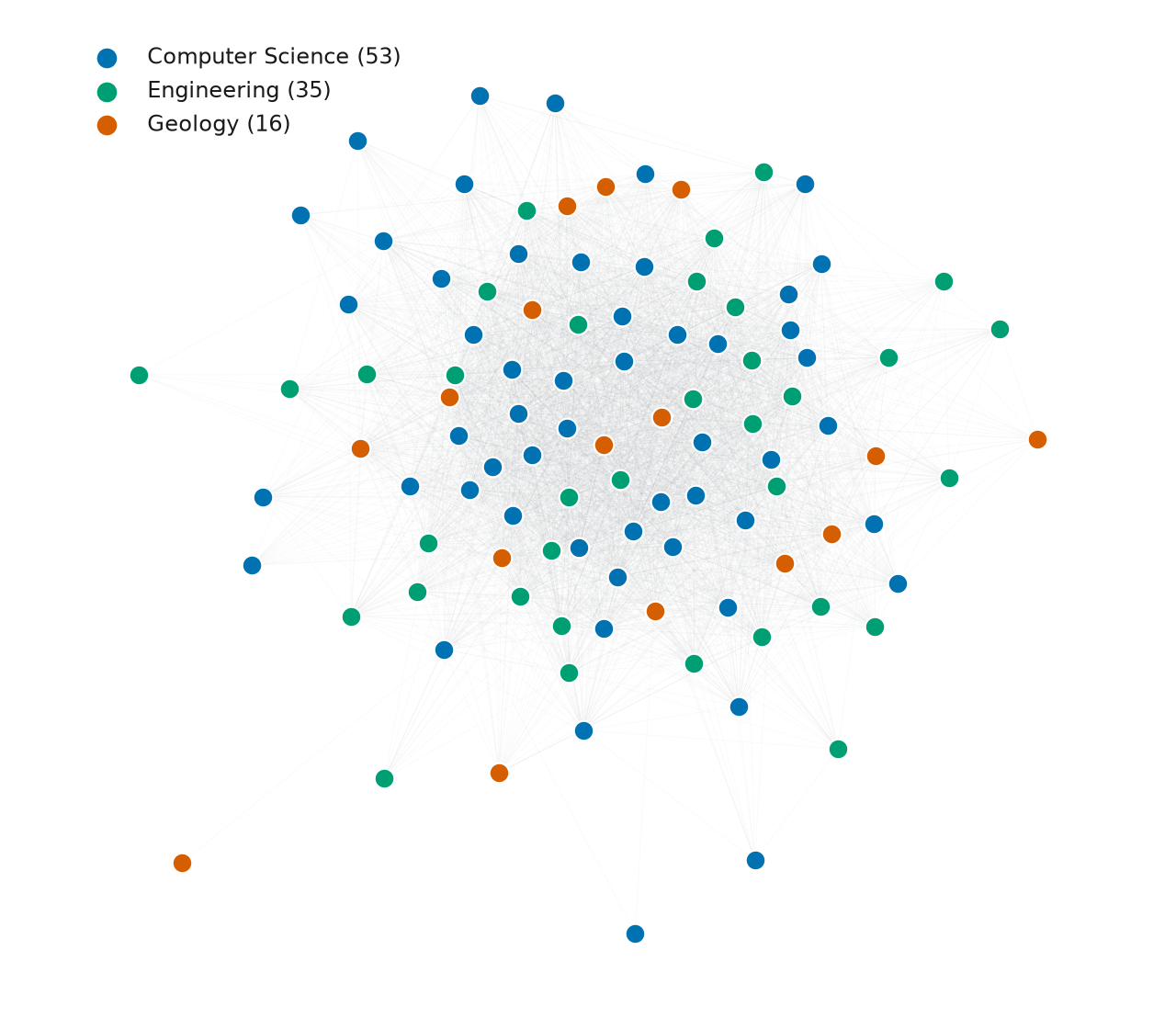
The morning group's network had 104 people and 3,345 edges in it. It was a single connected component with nobody left out, the average person was joined to 64 others, and the longest chain between any two people in the room was three steps.
Before I showed them, each tribe wrote down how many people they thought the average person would be joined to. The five morning tribes guessed 6, 4, 40, 5 and 5. The answer was 64. They had been in the room together for three days and every one of them underestimated how much they had in common, most of them by an order of magnitude.
The colours in that picture are the three subjects, and they are mixed all the way through. The network did not split by what anybody was there to study, which was the part I most wanted them to see.
Days five and six: spread
This was a game of catching something, and the idea for it is originally Paul Harper's rather than mine. One person started infectious, a roll of two dice decided whether a meeting passed it on, and you stayed infectious for three rounds before sitting at the side. We played it twice and I did not tell them what was different. In Run A you met one person a round. In Run B you met everybody in your tribe.
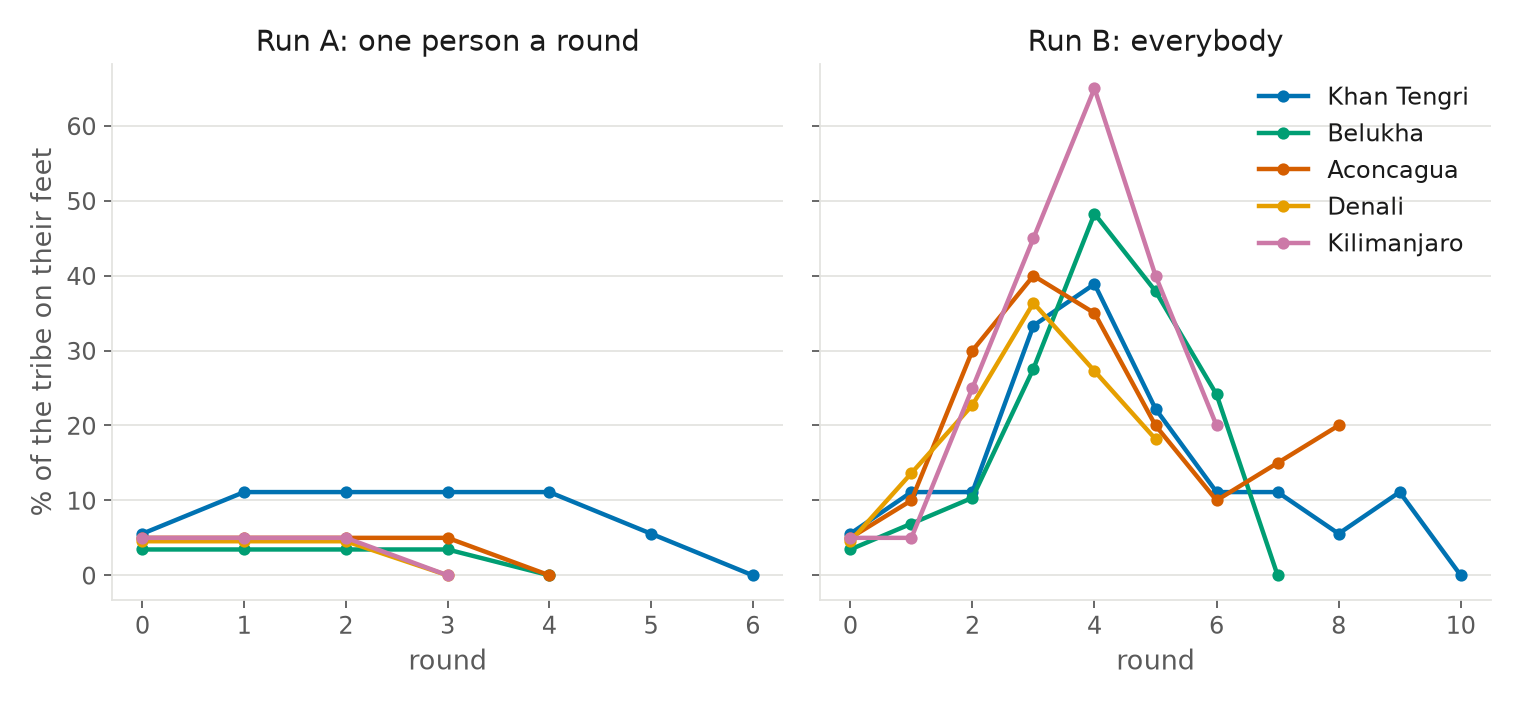
In Run A, 7 of the 109 students present ever caught it. In Run B, 92 did. Same disease, same dice, same three rounds of being infectious. The only thing that changed was how many people you met, and the reproduction number goes with it: about 0.25 in Run A and about 7 in Run B.
Run B was also the first time most of them had seen a curve that rises and then falls for a reason other than people getting better. It falls because the disease runs out of people to give it to.
The second half of the reveal brings back the network from day three. Their own network is a much better model of how something spreads than a tribe where everybody meets everybody, so I ran the same epidemic over it and asked the room who they would vaccinate. Tribes called out badge numbers and we tried them.
The heuristic we ended up comparing them against is a simple one: vaccinate whoever is joined to the most people who are not yet vaccinated, take them out, and count again, so a busy person whose friends are already covered drops down the list.
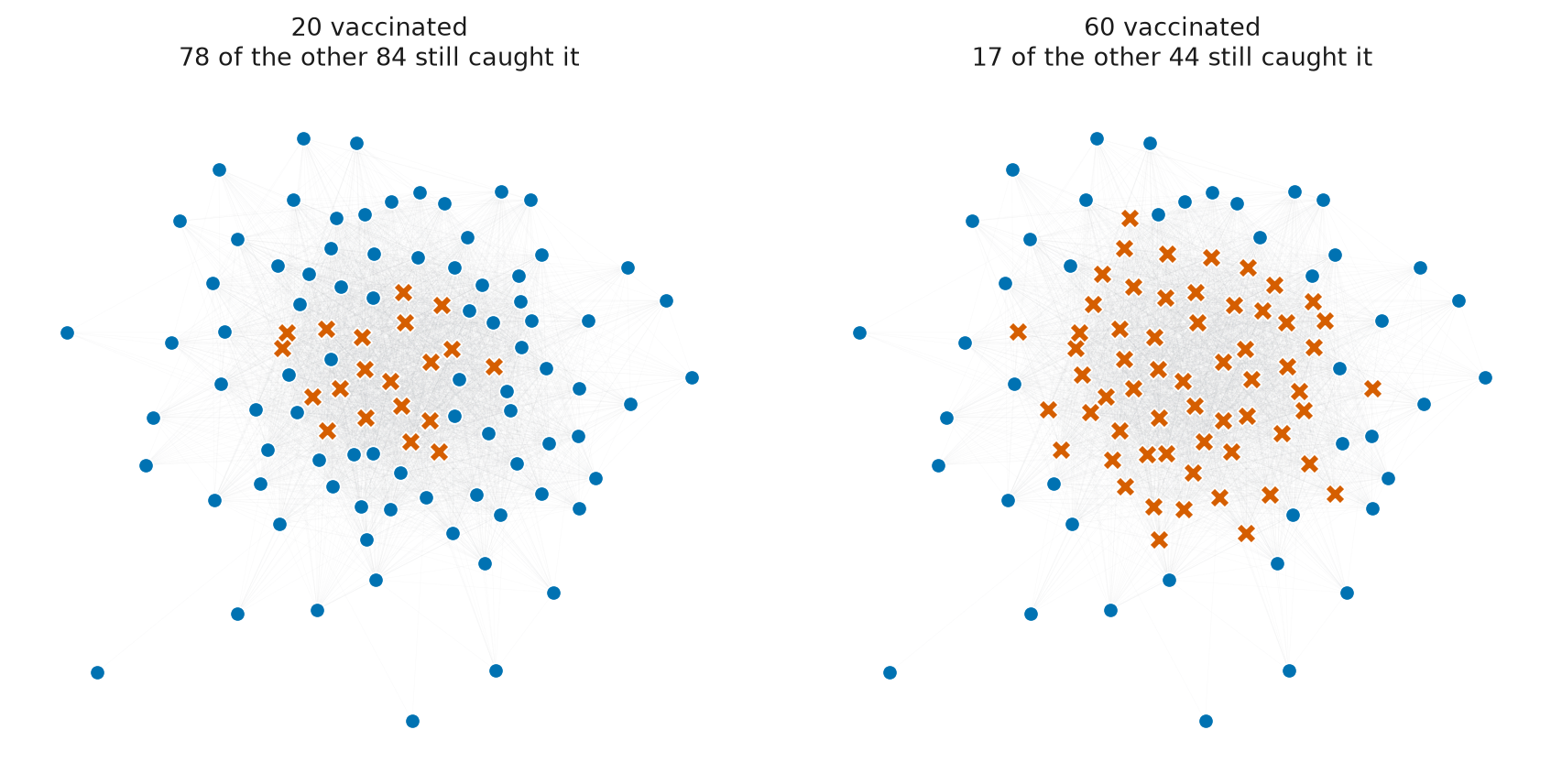
Vaccinating twenty people barely helps: 78 of the remaining 84 still catch it, against 80 if you had picked twenty people at random. This network is too well connected for a handful of hubs to matter, with the average person joined to 64 others.
Where the choice does start to pay is further along. At sixty vaccinated, picking the busiest leaves 17 people catching it, where choosing sixty at random leaves 39. At eighty it is 1 against 18. Who you choose only matters once you are choosing enough of them, which is not the lesson I expected to be teaching.
Days seven and eight: the pot
Six pods to a tribe, six dice each, and a pile in the middle. Every round each pod held out a closed fist with a die in it or not, and all six opened together. A die kept in your hand is worth three to your pod. A die in the middle is worth one to every pod in the tribe, so it is worth six in total. Giving is always worse for you and always better for your tribe, in every round, with no exceptions.
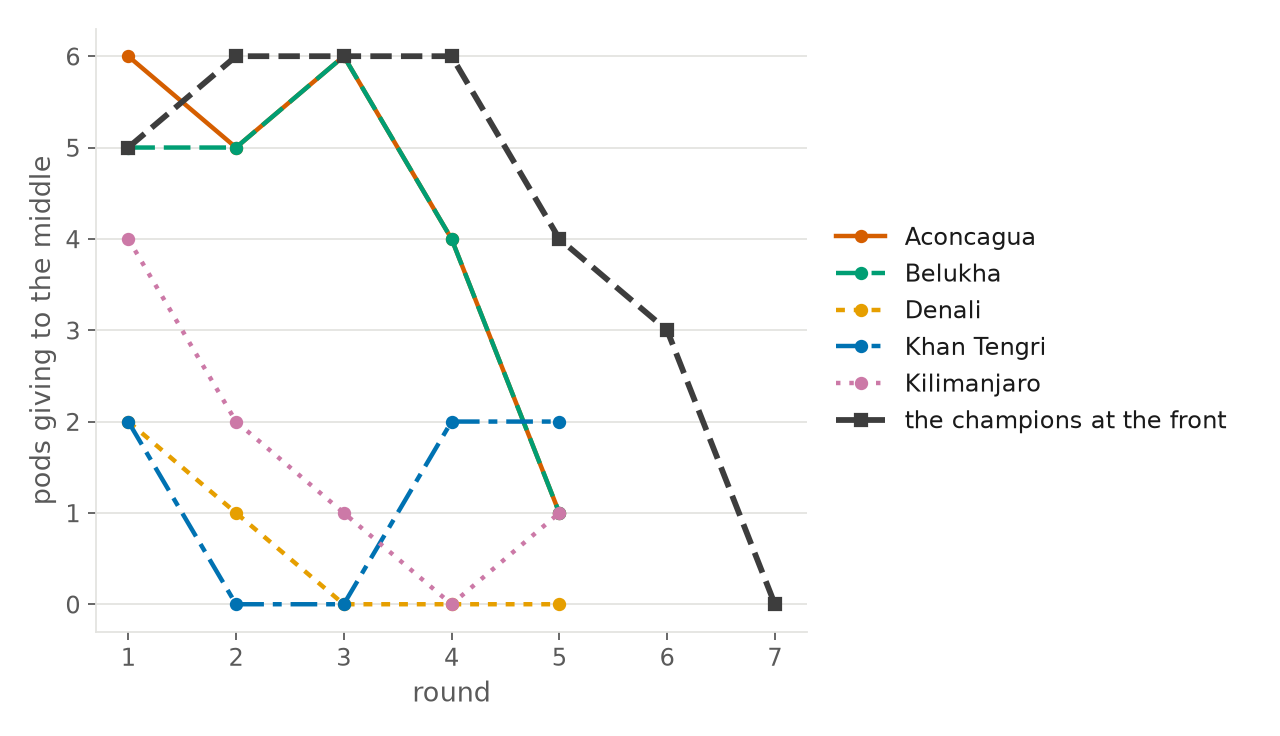
The five tribes finished with piles of 22, 21, 8, 6 and 3 dice. Two tribes nearly emptied their hands into the middle and one gave away three dice in total. Every tribe's last round was its lowest.
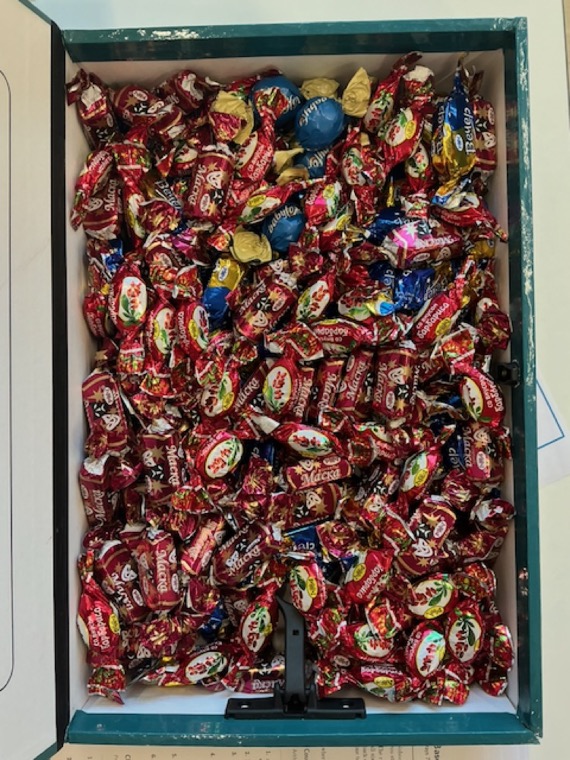
The line that surprised me was the dashed one. Those were the champions, one from each tribe, playing the same game at the front of the room in public with everyone watching. It was also the only version of the game that paid out: their points were worth chocolate, one chocolate a point, out of a box sitting where everybody could see it. I gave out a lot of chocolate.
They gave away 30 of their 36 dice, more than any tribe sitting at a table with its friends, and they did it with the only real stakes in the room. Every champion finished on between 30 and 36 points.
Day nine: forty players of werewolf
Day nine was deliberately slack. Four activities at two days each fills eight, and I wanted one spare in case something earlier overran. I also wanted to finish on something more relaxing than a ninth day of being measured.
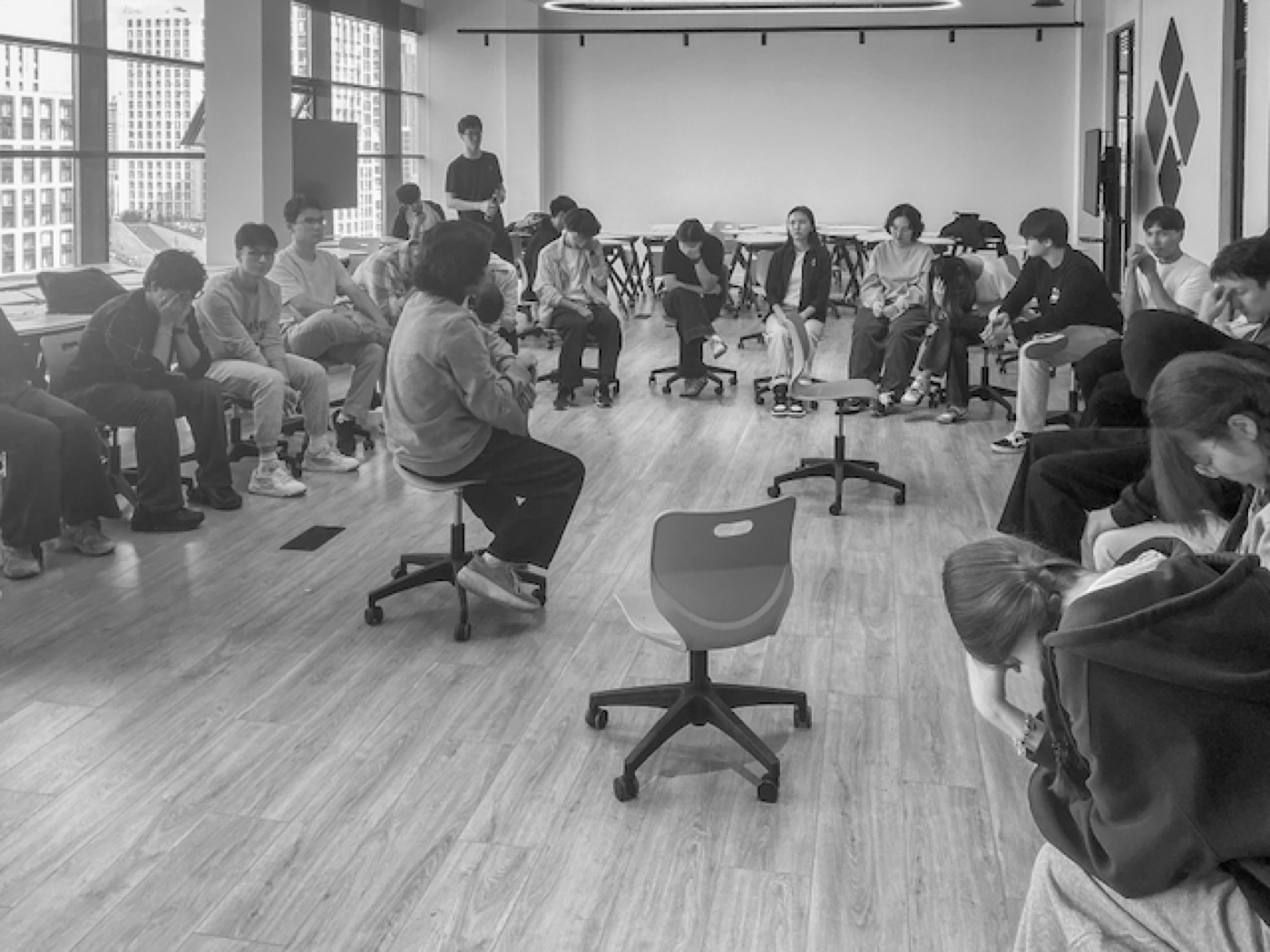
So: no data, no sheets, nothing to type. Motived by my preprint from earlier this year I planned to play some werewolf. In the morning we played a lot of smaller games with 15 players or so but in the afternoon we played a game with 40 players...
What I would change
The two-day rhythm works. The reveal days are the ones students talk about, and holding back the point of an activity until after it has been played is the single decision I would keep above all the others.
What I underestimated was the evening. Every capture day ends with me typing up paper, and on day seven that was fifty slips read one at a time. Some of that should move to a form next time, though not all of it: there is something about handing in a sealed piece of paper that a web form does not replicate.
The students
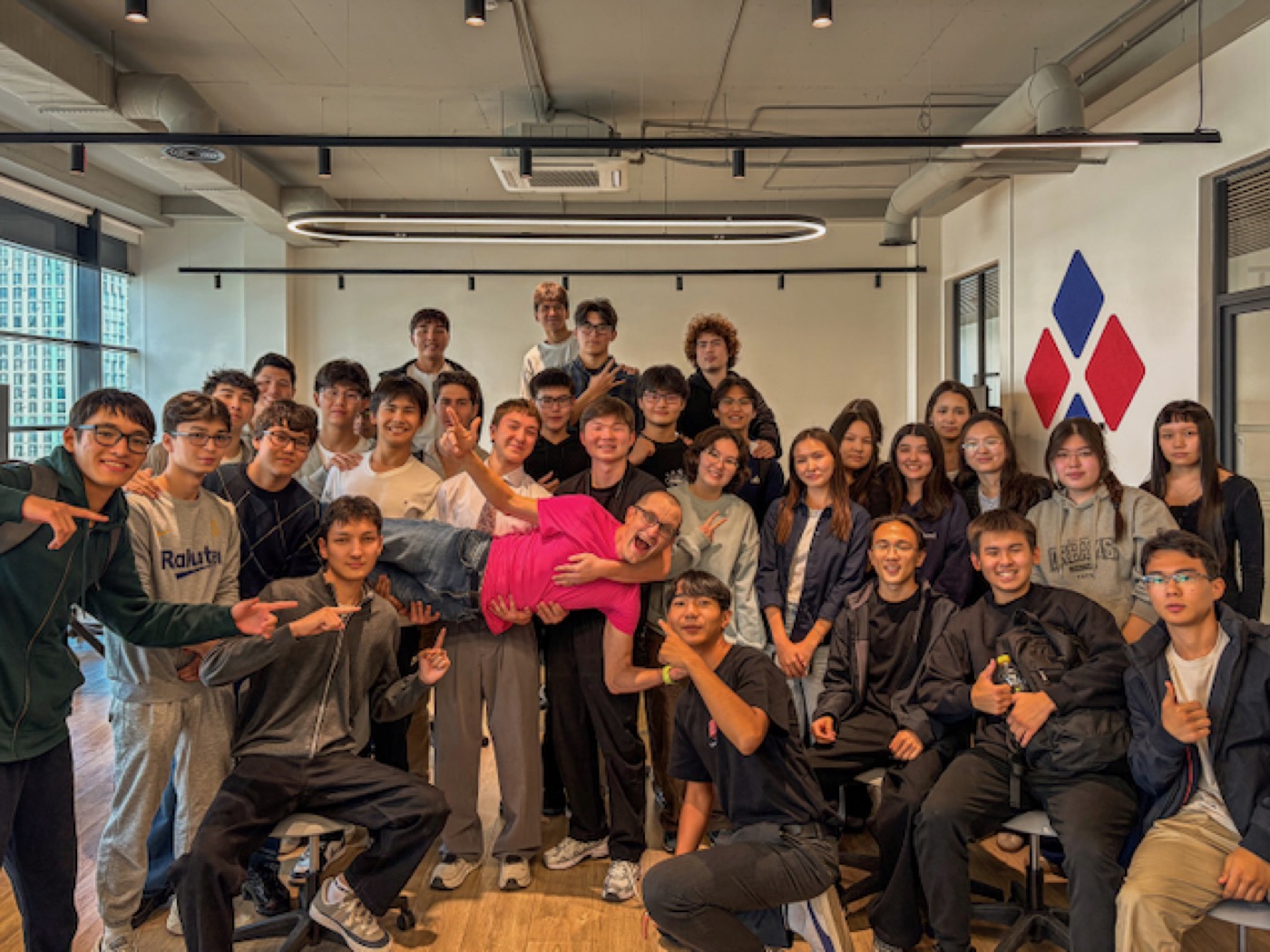
They were the best part of it. They were curious, motivated and fun to spend two weeks with.
I am scheduled to return in November and I am looking forward to seeing them.
Also on this trip
- I recorded some short social media pieces about our MSc AI + Data Science at Cardiff. It is a conversion course, so no prior coding is needed: applications close on 8 October and it starts on 25 October. Filming to camera is not something I am naturally good at, but the social media team were very patient with me.
- I gave a talk at the Kazakh University of Technology and Business named after K. Kulazhanov on the mathematics of cooperation from Axelrod to now: the 1980 tournaments, our work replicating and extending them, extortion in international trade, The Traitors, and a queueing model of the handover between ambulance services and emergency departments.
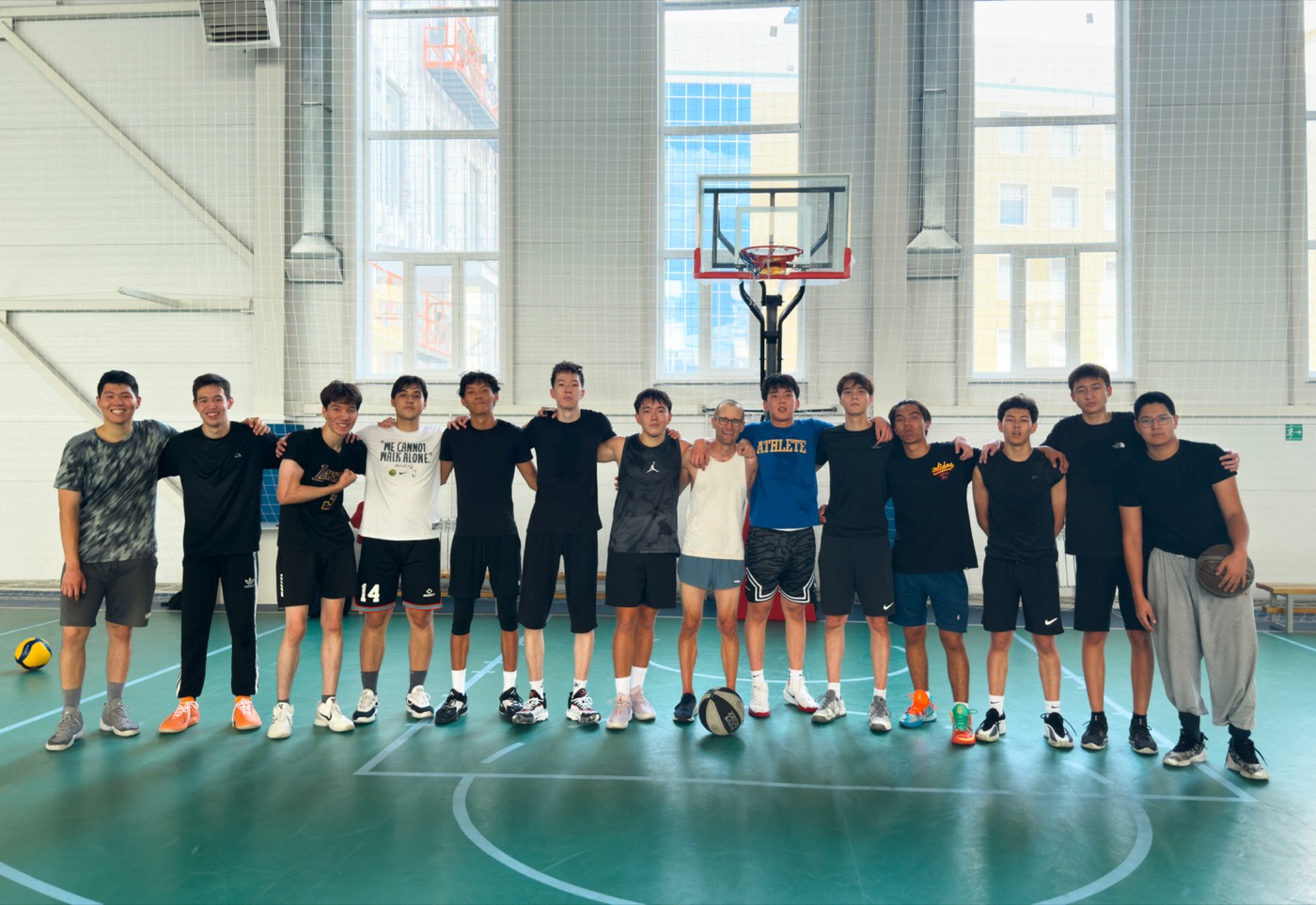
- I played basketball with the students. As in February they were faster, fitter and considerably more skilful than me, and as in February that is exactly why it is fun.