Start here
Whoever you are, this module is designed to be predictable. The first half is about using a mathematics-oriented set of Python tools; the second half is a group project in which you build a small library of your own. The schedule lists every topic; the Assessment page lists every component and how marks are combined.
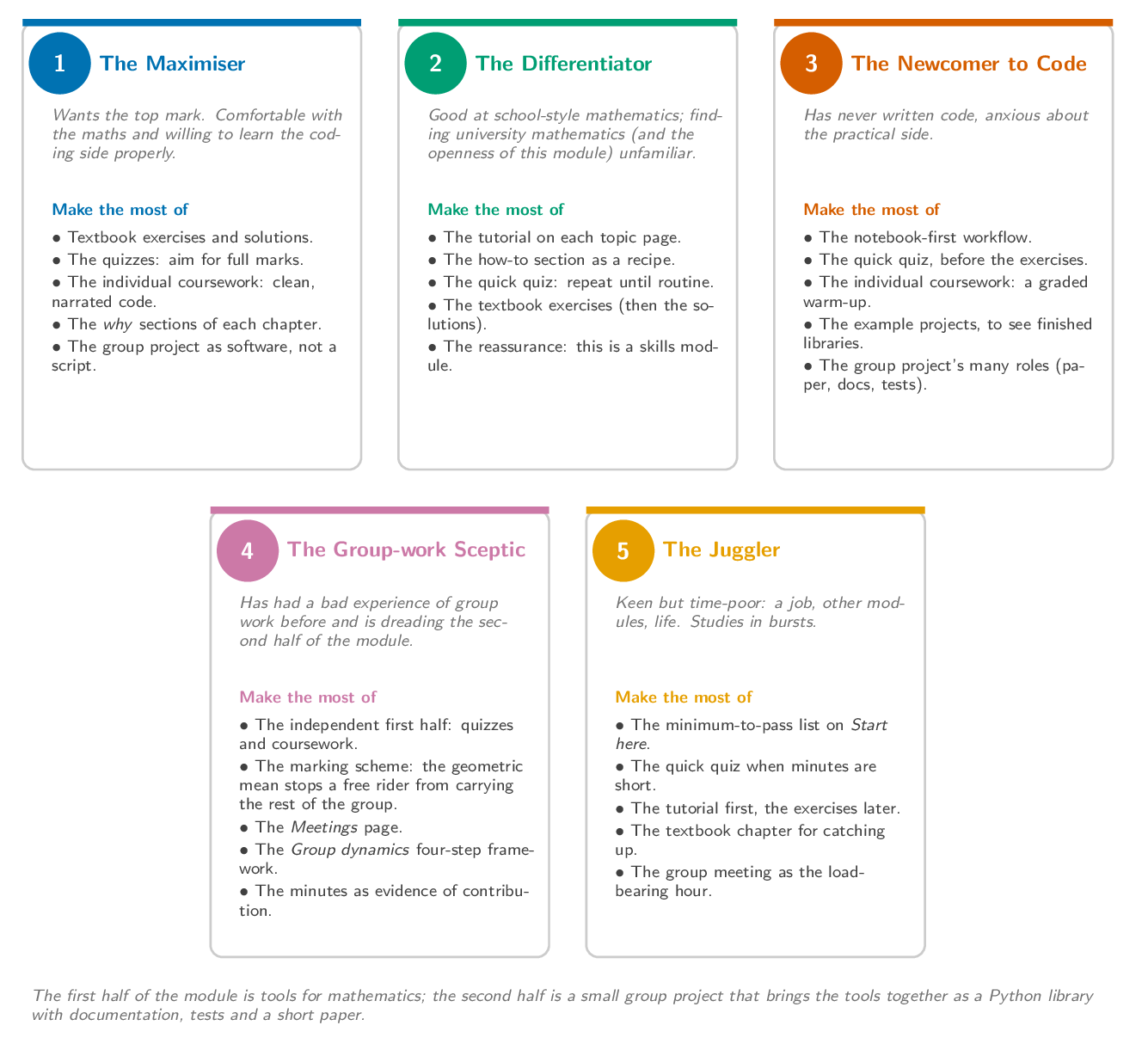
The five students below are caricatures, but most of us are a mix of them. Find the one closest to you and follow the signposts.
The minimum to pass
If you do nothing else, do this, in order:
- Read the Assessment page so you know how marks are combined: quizzes plus an individual coursework plus a group project, weighted as set out there.
- For every topic on the schedule, start with the quick quiz at the top of the page to check the basics, then work through the tutorial and the how-to from the textbook Python for mathematics.
- Submit each weekly quiz and the individual coursework on time.
- In the second half of the module, attend every group meeting and let the secretary record you as present in the minutes. Your individual contribution mark for the group project is based on this record.
That is the whole target. It is finite and it does not change much from year to year.
If you are aiming for the top mark
Going beyond the minimum:
- Work the exercises at the end of each textbook chapter, not only the tutorial. The solutions are there so you can check your reasoning.
- Aim for the top end of the quizzes: every quiz reshuffles, so you can keep attempting until you are answering quickly and confidently.
- Treat the individual coursework as a chance to write clean, well-narrated code; the marking scheme rewards communication as well as correctness.
- Use the facilitator-style chapters of the textbook (the why sections) to deepen your understanding beyond the tools.
- Take the group project seriously as a piece of software: read the Assessment marking scheme and aim for the exemplary level in every component.
- The example projects linked from the Assessment page are worked submissions. Read them as a model for what a strong submission looks like, not as a ceiling.
If you came here because you are good at differentiating
You may have signed up to a mathematics degree because school mathematics came naturally, and the openness of university mathematics (and of this module in particular) is taking some getting used to. The good news is that almost nothing on this module is school-style "find the answer" mathematics. It is mostly new skills: writing code, writing about mathematics, organising a project, working in a group.
- Treat each topic as a skill, not a test. The point of the tutorial on each topic page is to walk you through the tool; the point of the how-to is to show you the moves; the point of the exercises is to let you practise.
- The quick quiz at the top of each topic page reshuffles, so there is no harm in repeating it until the basics feel routine.
- You are not behind. By the end of the module you will be writing and testing your own Python library.
If you do not think you are a coder
You do not have to be a coder when you start. The module is structured so that the first half introduces tools one at a time, with worked examples, and the second half lets you build something using those tools as part of a group.
- Lean on the notebook-first workflow: every tools-for-mathematics topic starts in a notebook where you can explore.
- Use each topic's quick quiz to confirm the basics have stuck before the exercises.
- In the second half of the module, you do not need to write code from day one to be a valuable group member. Taking minutes, writing the paper, drafting the documentation and running the tests are all part of the project. The marking scheme rewards each of these.
- The example projects linked from the Assessment page show what finished libraries look like, with all of the pieces in place. They are worth reading even before you start writing your own code.
If you are dreading the group project
Group work can be a sore subject if you have had a bad experience of it before. The first half of the module is independent: every quiz, the individual coursework, and your engagement with the tutorials are all yours alone. The second half is deliberately scaffolded so that the group project is fair and not a free-for-all.
- Get the individual components done well early: the quizzes and the individual coursework are independent of any group and account for 40% of your mark.
- Read the Assessment page closely. Your individual mark for the group project is recorded weekly via the meeting minutes and combined with the group mark using a geometric mean, which prevents a free rider from carrying the rest of the group and rewards consistent contribution.
- Read the Meetings page so that you know what a meeting is for and what it is not for.
- Read the Group dynamics page. The four-step framework for handling disagreement is deliberately prescriptive; you should be able to recite it to yourself in the middle of a meeting.
If you are short on time
If you are juggling the module with everything else:
- Use the minimum-to-pass list above to prioritise.
- The quick quiz on each topic is the fastest way to test yourself when you only have a few minutes; the weekly quiz is also the cheapest mark in the module.
- Skim the textbook chapter before each topic's class; you do not have to read every section to make the tutorial worthwhile.
- During the group project the weekly meeting is the load-bearing hour: turn up, contribute, let the secretary record you present in the minutes.