<?xml version="1.0" encoding="utf-8"?><feed xmlns="http://www.w3.org/2005/Atom" ><generator uri="https://jekyllrb.com/" version="3.10.0">Jekyll</generator><link href="https://vknight.org/gt/feed.xml" rel="self" type="application/atom+xml" /><link href="https://vknight.org/gt/" rel="alternate" type="text/html" /><updated>2026-01-28T03:26:09+00:00</updated><id>https://vknight.org/gt/feed.xml</id><title type="html">Game Theory</title><subtitle>This module introduces students to the mathematical study of multiple interactive agent decision making. This is an introduction to Game Theory using programming through notions such as Nash Equilibria and Evolutionary Game Theory. Students will learn Game Theory in an active way through role playing and student-led activities.</subtitle><entry><title type="html">Group Coursework Feedback</title><link href="https://vknight.org/gt/2026/01/25/group-coursework-feedback.html" rel="alternate" type="text/html" title="Group Coursework Feedback" /><published>2026-01-25T00:00:00+00:00</published><updated>2026-01-25T00:00:00+00:00</updated><id>https://vknight.org/gt/2026/01/25/group-coursework-feedback</id><content type="html" xml:base="https://vknight.org/gt/2026/01/25/group-coursework-feedback.html"><![CDATA[<p>I have marked the group coursework and thank you all for your hard work. In
this post I will give a brief summary of the performance.</p>

<p>Here is a statistical summary:</p>

<pre><code>            marks
count  106.000000
mean    73.509434
std     12.449705
min      0.000000
25%     66.250000
50%     76.000000
75%     80.000000
max     95.000000
</code></pre>

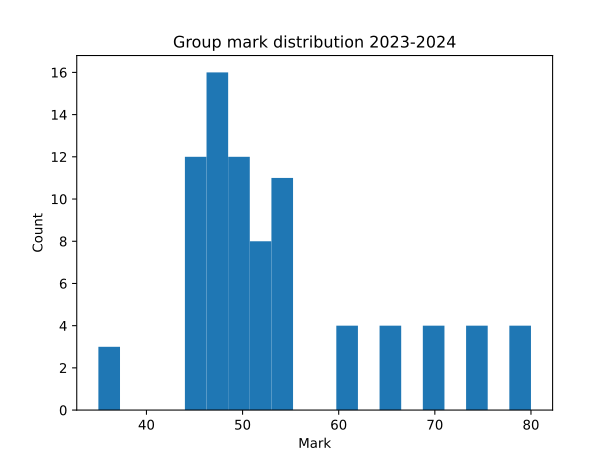
<p>You can see the distribution of marks here:</p>

<p><img src="/gt/assets/assessment/2025-2026/group/main.png" alt="" /></p>

<p>Overall, this cohort produced a strong and diverse set of projects, with a mean
mark of 73.5 and a median of 76 reflecting a high general standard of work. Many
projects demonstrated clear understanding of core game-theoretic ideas, and a
substantial number went beyond basic applications to explore evolutionary
dynamics, repeated games, learning, and simulation in creative and engaging
ways. The upper quartile of marks (80+) contained several genuinely impressive
pieces of work, showing depth of analysis, originality, and excellent
integration of theory, computation, and interpretation.</p>

<p>Across the cohort, the most successful projects shared a few common features: a
clearly stated mathematical model, well-explained simulations, and results that
were carefully interpreted rather than simply presented. Strong projects also
showed awareness of the distinction between static and dynamic solution
concepts, and used computational tools to extend insight rather than replace
explanation. Presentations were often a strength, with many students
communicating complex ideas clearly and confidently, even when the written paper
was more limited.</p>

<p>The main areas for improvement were also consistent across projects. A number of
submissions lacked sufficient detail about what was actually done, making
results difficult to interpret or reproduce. In some cases, modelling choices
were not clearly justified, or game-theoretic concepts were invoked without
being formally defined or correctly applied. Several projects would have
benefited from fewer ideas executed more carefully, clearer visualisation of
results, and tighter alignment with the methods taught in the course. Overall,
this was a very strong cohort, and the distribution of marks reflects both the
high quality of the best work and the clear learning progress made across the
group.</p>

<p>I will no longer have a research project component in this course in future
years and feel that this was a really nice set of projects to end on. Thank you
for your hard work.</p>

<p>If you’re interested you can find a list of all the past projects at
<a href="/gt/assessment/">the assessment page</a>.</p>

<p>I believe I have written detailed feedback on each of your projects but again: I
welcome any conversation you would like to have so please get in touch with me.</p>

<p>Thanks again for all the effort you put into this assessment. For those of you
graduating I wish you all the best.</p>]]></content><author><name></name></author><category term="about" /><category term="assessment" /><summary type="html"><![CDATA[I have marked the group coursework and thank you all for your hard work. In this post I will give a brief summary of the performance.]]></summary></entry><entry><title type="html">Revision week board</title><link href="https://vknight.org/gt/2026/01/12/revision-notes-on-matching-and-subgames.html" rel="alternate" type="text/html" title="Revision week board" /><published>2026-01-12T00:00:00+00:00</published><updated>2026-01-12T00:00:00+00:00</updated><id>https://vknight.org/gt/2026/01/12/revision-notes-on-matching-and-subgames</id><content type="html" xml:base="https://vknight.org/gt/2026/01/12/revision-notes-on-matching-and-subgames.html"><![CDATA[<p>Last week I went over two specific examples:</p>

<ul>
  <li>Matching games</li>
  <li>Subgame perfection</li>
</ul>

<p>You can find the board I wrote on <a href="/gt/assets/2025-2026/boards/2026-01-09/main.pdf">here</a></p>

<p>I worked through the Gale Shapley algorithm for the examples in that pdf and
then I went over the solutions to exercise 3 from the subgame perfection chapter
of the course.</p>]]></content><author><name></name></author><category term="subgame-perfection" /><category term="matching-games" /><summary type="html"><![CDATA[Last week I went over two specific examples:]]></summary></entry><entry><title type="html">An exam type question on the Replicator Dyanmics</title><link href="https://vknight.org/gt/2025/12/01/exam-type-replicatory-dynamics-question.html" rel="alternate" type="text/html" title="An exam type question on the Replicator Dyanmics" /><published>2025-12-01T00:00:00+00:00</published><updated>2025-12-01T00:00:00+00:00</updated><id>https://vknight.org/gt/2025/12/01/exam-type-replicatory-dynamics-question</id><content type="html" xml:base="https://vknight.org/gt/2025/12/01/exam-type-replicatory-dynamics-question.html"><![CDATA[<p>In class today we finished looking at an exam type question for the Replicator Dynamics
equation I started on Friday.
You can find the board I wrote on <a href="/gt/assets/2025-2026/boards/2025-12-01/main.pdf">here</a></p>

<p>You can see the recordings here:</p>
<ul>
  <li><a href="https://cardiff.cloud.panopto.eu/Panopto/Pages/Viewer.aspx?id=25e2eeed-59b1-471f-8259-b3a200b42db2">From Friday</a></li>
  <li><a href="https://cardiff.cloud.panopto.eu/Panopto/Pages/Viewer.aspx?id=8397b830-c29b-4a36-b843-b3a200b4d637">From Today</a></li>
</ul>

<p>You can find this example and the solutions in the exercises section of the Game
Theory notes.</p>]]></content><author><name></name></author><category term="replicator-dynamics" /><summary type="html"><![CDATA[In class today we finished looking at an exam type question for the Replicator Dynamics equation I started on Friday. You can find the board I wrote on here]]></summary></entry><entry><title type="html">Discussion of principles of presentations</title><link href="https://vknight.org/gt/2025/11/24/presentation.html" rel="alternate" type="text/html" title="Discussion of principles of presentations" /><published>2025-11-24T00:00:00+00:00</published><updated>2025-11-24T00:00:00+00:00</updated><id>https://vknight.org/gt/2025/11/24/presentation</id><content type="html" xml:base="https://vknight.org/gt/2025/11/24/presentation.html"><![CDATA[<p>In class today I gave a demonstration of a presentation to go with the paper I
that you can find <a href="/gt/assets/examples/not-reproducing-axelrods-first-tournament/paper/main.pdf">here</a>.</p>

<p>You can find a recording of the class <a href="https://cardiff.cloud.panopto.eu/Panopto/Pages/Viewer.aspx?id=5180e959-f69a-4fc1-aac9-b39a00a55a20">here</a></p>

<p>We finished the class by discussing my notes on principles for presentation: <a href="https://vknight.org/pop/">https://vknight.org/pop/</a>.</p>

<p>One group from previous years put their presentation on 
YouTube and you can find it <a href="https://youtu.be/syt0b0GI2wA?si=_A7LOJMr0HDU3TUm">here</a>.</p>]]></content><author><name></name></author><category term="presentation" /><summary type="html"><![CDATA[In class today I gave a demonstration of a presentation to go with the paper I that you can find here.]]></summary></entry><entry><title type="html">An exam type question on the Moran Process</title><link href="https://vknight.org/gt/2025/11/21/exam-type-moran-question.html" rel="alternate" type="text/html" title="An exam type question on the Moran Process" /><published>2025-11-21T00:00:00+00:00</published><updated>2025-11-21T00:00:00+00:00</updated><id>https://vknight.org/gt/2025/11/21/exam-type-moran-question</id><content type="html" xml:base="https://vknight.org/gt/2025/11/21/exam-type-moran-question.html"><![CDATA[<p>In class today we looked at an exam type question for the Moran process.
You can find the board I wrote on <a href="/gt/assets/2025-2026/boards/2025-11-21/main.pdf">here</a></p>

<p>You can see a recording of this <a href="https://cardiff.cloud.panopto.eu/Panopto/Pages/Viewer.aspx?id=2ea24413-3f57-41d4-a43c-b39800d6f63d">here</a>.</p>]]></content><author><name></name></author><category term="moran-process" /><summary type="html"><![CDATA[In class today we looked at an exam type question for the Moran process. You can find the board I wrote on here]]></summary></entry><entry><title type="html">Writing review of example</title><link href="https://vknight.org/gt/2025/11/17/writing.html" rel="alternate" type="text/html" title="Writing review of example" /><published>2025-11-17T00:00:00+00:00</published><updated>2025-11-17T00:00:00+00:00</updated><id>https://vknight.org/gt/2025/11/17/writing</id><content type="html" xml:base="https://vknight.org/gt/2025/11/17/writing.html"><![CDATA[<p>In class today we look at the <a href="https://vknight.org/gt/assets/examples/the-evolution-of-the-two-thirds-of-the-average-game/paper/main.pdf">example paper</a>
as well as the marking criteria.
<strong>Marking the paper alone is not a good exercise as the entire project also
requires the presentation which we will look at next week.</strong></p>

<p>You can find a recording of the class <a href="https://cardiff.cloud.panopto.eu/Panopto/Pages/Viewer.aspx?id=34a30ee6-fb06-4c7b-9c94-b39300a556b2">here</a>.</p>

<p>Below is a summary of my recollection of our conversation:</p>

<ul>
  <li>The paper should:
    <ul>
      <li>Say what you have done.</li>
      <li>Say how you did it.</li>
      <li>Say what you found.</li>
      <li>Say why (answer “so what?”).</li>
    </ul>
  </li>
  <li>We spoke about whether or not to use visualisation in a paper. Without this
being a rule I’d suggest it is a good idea when appropriate.</li>
  <li>We spoke about the need to include reference (in the 2 pages).</li>
  <li>We spoke about code and where to include it.</li>
  <li>We spoke about levels of depth (and how specifically the example paper had
little depth).</li>
</ul>

<p>I asked you as a class to mark the project, based on the paper alone: you came
to an average of about 61/100.</p>

<p>I threw it in to Chat GPT and it gave it a mark of 52/100.</p>

<p>We will come to the mark that I feel it warrants but only after discussing the
presentation.</p>]]></content><author><name></name></author><category term="writing" /><category term="about-the-course" /><summary type="html"><![CDATA[In class today we look at the example paper as well as the marking criteria. Marking the paper alone is not a good exercise as the entire project also requires the presentation which we will look at next week.]]></summary></entry><entry><title type="html">Social Choice and Cooperative Games</title><link href="https://vknight.org/gt/2025/11/14/social-choice-and-shapley-value.html" rel="alternate" type="text/html" title="Social Choice and Cooperative Games" /><published>2025-11-14T00:00:00+00:00</published><updated>2025-11-14T00:00:00+00:00</updated><id>https://vknight.org/gt/2025/11/14/social-choice-and-shapley-value</id><content type="html" xml:base="https://vknight.org/gt/2025/11/14/social-choice-and-shapley-value.html"><![CDATA[<p>In class today we looked at <a href="https://vknight.org/gtb/main-13/">social choice</a> and 
<a href="https://vknight.org/gtb/main-14/">cooperative games</a>.</p>

<p>You can see a recording of this <a href="https://cardiff.cloud.panopto.eu/Panopto/Pages/Viewer.aspx?id=8ff7852e-a0f2-46bd-9da3-b392010b098b">here</a>.</p>

<h3 id="social-choice">Social Choice</h3>

<p>For the purpose of studying social choice I asked you all to vote on which topic
from game theory you wanted us to revise on Monday.</p>

<p>Using the first past the post system: the Moran Process got 11 votes whilst the
other subjects got a total of 19.</p>

<p>Following this I used a different tool which uses more advanced social choice
methodology to get your decision. This site asked you to rank all your choices
and then gives a decision: it in fact resulted in the same outcome (but this is
not necessarily the case). You can see the results
<a href="https://stablevoting.org/results/6915c031acad2cab93ca1ddc?oid=jsLVNa1q">here</a>.</p>

<p>Following this I discussed the chapter on social choice highlighting:</p>

<ul>
  <li>Arrow’s impossibility theorem: there is no perfect system.</li>
  <li>Condorcet’s method which might not always lead to a decision.</li>
  <li>Borda’s scoring method which does always lead to a decision.</li>
</ul>

<h3 id="shapley-value">Shapley Value</h3>

<p>I then asked for 3 volunteers to try and land paper plans in a target.</p>

<p>You can find the results of this in the blue and red part of the so called
<a href="https://vknight.org/gtb/main-14/#definition-characteristic-function-game">characteristic function game</a>.</p>

<p>You can find the calculations we made on the board here:</p>

<p><img src="/gt/assets/2025-2026/boards/2025-11-14/main.jpg" alt="" /></p>

<p>(Note that the value of Tom and Franks coalition in the blue game should be 6.)</p>

<p>At the very end of the class, after we computed the Shapley value for the red
game Tom asked an excellent question:</p>

<blockquote>
  <p>Since I can get 3 alone and the Shapley value gets me 17/11 why would I act as
part of the coalition?</p>
</blockquote>

<p><strong>I made a mistake here, saying that something must be wrong.</strong></p>

<p>In fact the game is not <a href="https://vknight.org/gtb/main-14/#sec-definition-of-superadditive-characteristic-function">super additive</a> and so the 
Shapley value here does not guarantee so called individual rationality.</p>

<p>Tom suggested a change to the characteristic function that would ensure it is
super additive that would ensure this.</p>

<p>You can find a Jupyter notebook
<a href="/gt/assets/2025-2026/nbs/shapley-value.ipynb">here</a> with code to
carry out the calculations for each other these scenarios.</p>]]></content><author><name></name></author><category term="social-choice" /><category term="cooperative-games" /><summary type="html"><![CDATA[In class today we looked at social choice and cooperative games.]]></summary></entry><entry><title type="html">Matching games and auctions</title><link href="https://vknight.org/gt/2025/11/10/matching-games-and-suction-games.html" rel="alternate" type="text/html" title="Matching games and auctions" /><published>2025-11-10T00:00:00+00:00</published><updated>2025-11-10T00:00:00+00:00</updated><id>https://vknight.org/gt/2025/11/10/matching-games-and-suction-games</id><content type="html" xml:base="https://vknight.org/gt/2025/11/10/matching-games-and-suction-games.html"><![CDATA[<p>In class on Friday we looked at <a href="https://vknight.org/gtb/main-11/">matching-games</a> and today we looked at
<a href="https://vknight.org/gtb/main-12/">auctions</a>.</p>

<p>You can see a recording of this:</p>

<ul>
  <li><a href="https://cardiff.cloud.panopto.eu/Panopto/Pages/Viewer.aspx?id=778eb9d3-e2c0-4212-abd2-b3890108341e">here for matching games</a>.</li>
  <li><a href="https://cardiff.cloud.panopto.eu/Panopto/Pages/Viewer.aspx?id=34e3c6db-636a-4d71-87dc-b38c00a55902">here for auctions</a>.</li>
</ul>

<h3 id="matching-games">Matching Games</h3>

<p>For Matching games I started by asking you to come up with individual rankings
for physicists to work with mathematicians and versa:</p>

<p><img src="/gt/assets/2025-2026/boards/2025-11-07/main.jpg" alt="" /></p>

<p>Using this we described potential matchings. In our particular case this always
lead to a bad matching for Turing but this was nonetheless the only matching
that was stable.</p>

<p>We then spoke about the Gale-Shapley algorithm which is a powerful yet simple
tool for finding stable matchings.</p>

<h3 id="auctions">Auctions</h3>

<p>Today we started with another auction for a £5 note.</p>

<p>I started by asking you all to write down what you thought was the value of that
£5 to you. Some of you assigned quite a high value (more than £5) and some quite
a low value (less than £5).</p>

<p><img src="/gt/assets/2025-2026/boards/2025-11-07/main.jpg" alt="" /></p>

<p>After that I said that the auction would be that the highest bidder would win
the £5 and pay the second highest bid.</p>

<p>This lead to a discussion about what the optimal bidding pattern was based on
value. Tim, who “won” the £5 (and owes me £7) had a strategy based on the
assumption that everyone would bid <em>near</em> £5 so his winning bid of £50 would
work.</p>

<p>There are two theorems with the associated chapter, the first of which actually
shows in expectation the optimal bid is to in fact bid your value.</p>]]></content><author><name></name></author><category term="matching-games" /><category term="auctions" /><summary type="html"><![CDATA[In class on Friday we looked at matching-games and today we looked at auctions.]]></summary></entry><entry><title type="html">Routing Games: Pigou’s example</title><link href="https://vknight.org/gt/2025/11/03/routing-games.html" rel="alternate" type="text/html" title="Routing Games: Pigou’s example" /><published>2025-11-03T00:00:00+00:00</published><updated>2025-11-03T00:00:00+00:00</updated><id>https://vknight.org/gt/2025/11/03/routing-games</id><content type="html" xml:base="https://vknight.org/gt/2025/11/03/routing-games.html"><![CDATA[<p>In class today we looked at the <a href="https://vknight.org/gtb/main-10/">Routing Games</a>. 
We did this by considering Pigou’s Example.</p>

<p>You can see a recording of this <a href="https://cardiff.cloud.panopto.eu/Panopto/Pages/Viewer.aspx?id=f0229828-d3d4-4566-b468-b38500a54ea6">here</a>.</p>

<p>Pigou’s example is a simple model of congestion there are 2 choices available to
traffic, the first is not affected by traffic, the other is heavily affected by
traffic (the more people using it, the worse it is).</p>

<p>This simple situation is modelling as a routing game which requires the network
diagram and congestion functions you can see here:</p>

<p><img src="/gt/assets/2025-2026/boards/2025-11-03/main.jpg" alt="" /></p>

<p>The calculations we carried out included:</p>

<ul>
  <li>Identifying the most <em>efficient</em> flow: half the population take each edge.</li>
  <li>Identifying the Nash flow: the entire population using the shortcut (making it
as slow as the other way)</li>
  <li>Finding the Nash flow by optimising the Potential function.</li>
  <li>Finding the optimal flow by finding the Nash flow for a slightly modified
game.</li>
</ul>

<p>The final thing I spoke about was Braess’ Paradox which is an important idea, it
is theoretically interesting but empirically has real negative implications:
adding capacity to networks may lead to a worse performance.</p>]]></content><author><name></name></author><category term="routing-games" /><summary type="html"><![CDATA[In class today we looked at the Routing Games. We did this by considering Pigou’s Example.]]></summary></entry><entry><title type="html">Hawks, Doves and Dice</title><link href="https://vknight.org/gt/2025/10/31/moran-process-and-kkt.html" rel="alternate" type="text/html" title="Hawks, Doves and Dice" /><published>2025-10-31T00:00:00+00:00</published><updated>2025-10-31T00:00:00+00:00</updated><id>https://vknight.org/gt/2025/10/31/moran-process-and-kkt</id><content type="html" xml:base="https://vknight.org/gt/2025/10/31/moran-process-and-kkt.html"><![CDATA[<p>In class today we looked at the <a href="https://nashpy.readthedocs.io/en/stable/text-book/moran-process.html">Moran
Process</a> and the 
<a href="https://vknight.org/gtb/main-17/">Karush-Kuhn-Tucker conditions</a>. We did this by
considering the <a href="https://vknight.org/gtb/main-8/#inknuM1ypp">Hawk Dove game</a>.</p>

<p>You can see a recording of this <a href="https://cardiff.cloud.panopto.eu/Panopto/Pages/Viewer.aspx?id=724c904c-da51-40e8-a34b-b38200d6c839">here</a>.</p>

<p><strong>The Moran Process</strong></p>

<p>The Moran process is a game theoretic model of evolution. One of the differences
from the <a href="/gt/topics/replicator-dynamics.html">Replicator Dynamics equation</a> is that the population is assumed to be
<strong>finite</strong>: so we assumed there is a finite population of \(N\) individuals
that can be of any of the types that correspond to actions of the underlying
Norma Form Game.</p>

<p>In the example of the Hawk Dove game that we played in class we assumed there
were \(N=3\) individuals and the question we attempted to understand was: <em>if
we introduce a Hawk in to a population of Doves, what will happen?</em></p>

<hr />

<p>The Moran process then follows the following:</p>

<ol>
  <li>Calculate the fitness of all individuals: everyone in the population plays
the Normal Form game against everyone else. Their utility (or fitness)
is given by their type and the type of the individual they play with.</li>
  <li>Randomly select an individual for copying proportional to their fitness.</li>
  <li>Randomly select an individual for removal (all individuals are equally likely
to be removed).</li>
  <li>Create a new individual of the same type as the one selected in step 2.</li>
  <li>Remove the individual selected in step 3.</li>
</ol>

<p>Repeat that process until there is a single type of individual in the
population.</p>

<hr />

<p>In class we used dice to simulate the above and obtained a
probability of 47% of the Hawk taking over.</p>

<p><a href="/gt/assets/2025-2026/nbs/hawks-doves.ipynb">Here</a> is a notebook with some numeric simulations of the probabilities. If you
look through the notes you can see approaches for calculating exact fixation
probabilities.</p>

<p><strong>KKT Conditions</strong></p>

<p>After that we spoke about the <a href="https://vknight.org/gtb/main-17/">Karush-Kuhn-Tucker Condition</a> which I described
as a rigorous mathematical set of rules for a simple idea of where optima might
be on a constrained region.</p>

<p>You can find the notebook I used to draw the function we looked at
<a href="">here</a>.</p>]]></content><author><name></name></author><category term="moran-process" /><summary type="html"><![CDATA[In class today we looked at the Moran Process and the Karush-Kuhn-Tucker conditions. We did this by considering the Hawk Dove game.]]></summary></entry></feed>